





What's Happening?
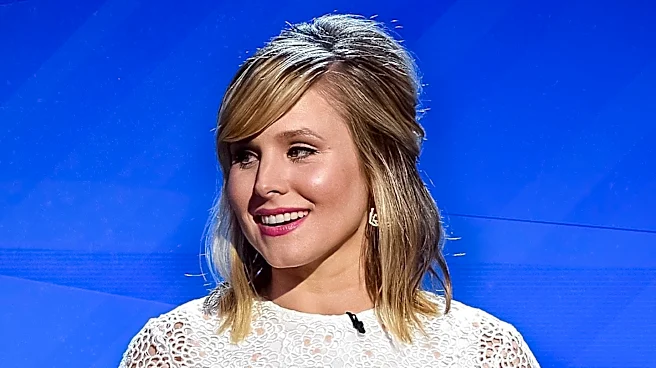
Actresses Drew Barrymore and Kristen Bell recently appeared on 'The Drew Barrymore Show' where they underwent a live, on-air 'make-under.' Both actresses removed their hair extensions and wiped off their makeup, presenting themselves bare-faced to the audience.
Kristen Bell initiated the idea, crediting Barrymore's free-spirited approach to daytime television for making such a segment possible. Bell explained that her daughters, Lincoln (13) and Delta (11), inspired her to re-evaluate the meaning of makeup, shifting her perspective from concealment to creativity. This on-air transformation was not merely for entertainment but served as a statement about embracing natural beauty and challenging societal pressures regarding appearance. Barrymore has previously engaged in similar bare-faced segments on her show, including one with Millie Bobby Brown in 2024.
Why It's Important?
This on-air transformation by Drew Barrymore and Kristen Bell holds significance in the broader conversation about beauty standards and self-acceptance in the U.S. entertainment industry and society. By publicly shedding their makeup and hair extensions, these prominent figures challenge the often-unrealistic beauty ideals perpetuated by media. This act can empower viewers, particularly young women, to feel more comfortable in their natural appearance and reduce the pressure to conform to heavily made-up images. Kristen Bell's motivation, stemming from her daughters' curiosity about makeup, highlights a generational shift in how beauty is perceived and taught. It promotes a message that beauty is about creativity and self-expression rather than hiding perceived flaws, potentially influencing a more positive body image culture among younger audiences and encouraging a more authentic representation of women in media.
Beyond the Headlines
Beyond the immediate visual impact, the bare-faced transformation by Drew Barrymore and Kristen Bell touches upon deeper ethical and cultural dimensions within the beauty industry and celebrity culture. It subtly critiques the pervasive influence of cosmetic enhancements and the constant pressure on public figures to maintain a flawless image. By openly embracing their natural looks, they contribute to a growing movement that advocates for authenticity and self-acceptance, potentially fostering a more inclusive definition of beauty. This act also raises questions about the role of media in shaping perceptions of beauty and the responsibility of celebrities in promoting healthy self-image. It encourages a dialogue about the psychological impact of beauty standards and the importance of internal validation over external appearance, particularly in an era dominated by curated online personas.