







What's Happening?
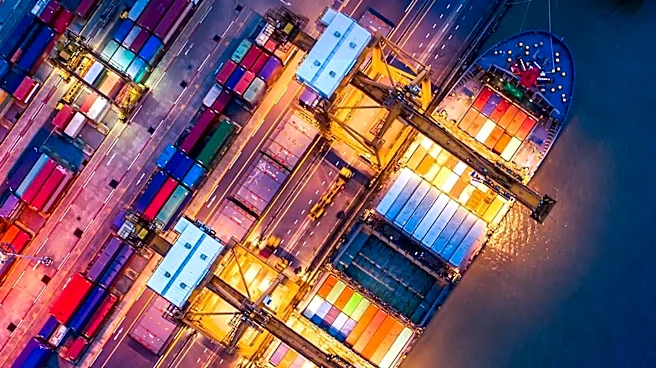
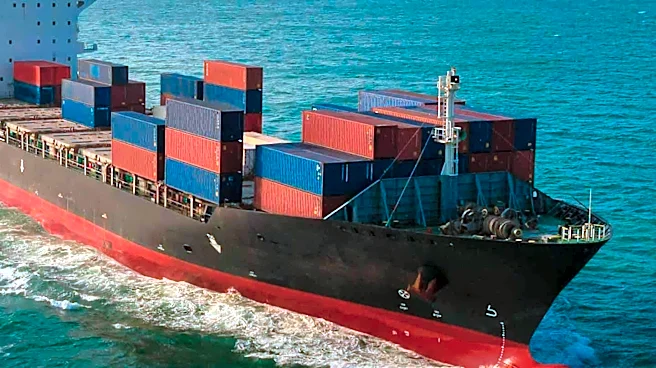
A recent study by the American Enterprise Institute (AEI) and the National Bureau of Economic Research reveals that disruptions to U.S.-bound shipping routes have led to substantial losses in economic output. Analyzing satellite vessel-tracking data from
2016 to 2025, researchers found that utilization losses during recent disruptions ranged from 20 to 40 percentage points, often beginning months before visible port congestion. The 2021 West Coast crisis resulted in a 0.69% loss of output, while the 2023-2024 Red Sea attacks cost 0.35% of output. The study models these disruptions within a general equilibrium framework, where firms reallocate a common fleet without fully accounting for the congestion they create, and importers adjust sourcing based on route profitability. Naval protection of Red Sea shipping generated benefits of 0.04-0.08% of output, at a fiscal cost of 0.02%.
Why It's Important?
These findings underscore the critical vulnerability of the U.S. economy to disruptions in global shipping routes. The significant percentage of output lost due to these events translates into billions of dollars, impacting various sectors from manufacturing and retail to consumer goods. Such disruptions lead to increased costs for businesses, higher prices for consumers, and potential shortages of goods. The study highlights that traditional economic models often underestimate the true welfare cost of these disruptions by treating them merely as 'iceberg-cost shocks.' The reallocation of shipping capacity by firms, without internalizing the congestion created, exacerbates the problem. This research provides a more accurate understanding of the macroeconomic and trade-policy implications, emphasizing the need for robust strategies to mitigate these risks and protect economic stability.
What's Next?
The study suggests that tariffs could potentially decongest taxed routes, offsetting or even reversing their conventional welfare cost, by influencing shipping patterns. This implies that trade policy could be leveraged not just for revenue or protection, but also as a tool for supply chain management. Further research and policy discussions will likely focus on developing more sophisticated models that account for the complex interplay between shipping capacity, congestion, and firm behavior. Policymakers may explore a combination of naval protection, diplomatic efforts to secure key shipping lanes, and economic incentives or disincentives to manage shipping traffic and reduce congestion. The insights from this study will be crucial for informing future trade and economic policies aimed at enhancing the resilience of U.S.-bound supply chains.
Beyond the Headlines
The AEI study delves deeper than immediate economic losses, revealing systemic issues within global shipping. The finding that utilization losses begin months before visible port congestion points to a need for earlier detection and proactive intervention mechanisms. It also raises questions about the efficiency and coordination within the global shipping industry, particularly regarding how firms manage shared resources like shipping fleets and the potential for market failures when individual firms do not internalize the broader costs of congestion. The discussion around tariffs as a decongestion tool introduces a novel perspective on trade policy, suggesting that economic instruments can have unexpected, positive externalities on logistical efficiency. This could lead to a re-evaluation of how trade agreements and regulations are designed, with a greater emphasis on their impact on supply chain fluidity and national economic security, moving beyond traditional considerations of market access and competition.