



What's Happening?
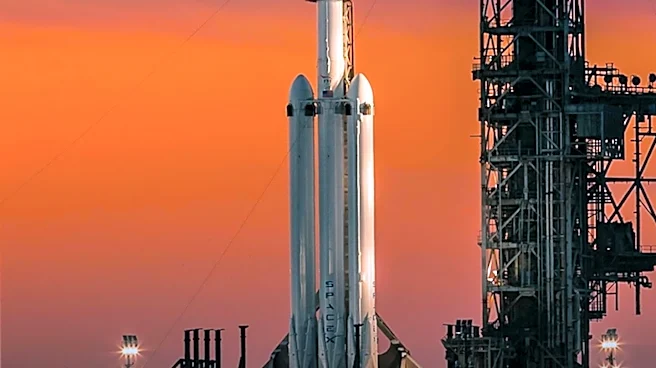
SpaceX intends to retire its Falcon 9 rocket, along with its Falcon Heavy variant, once the company's next-generation Starship system achieves regular operational flights. Elon Musk, SpaceX founder and CEO, announced this plan, stating that once Starship is flying
reliably multiple times per week, production resources will shift to Starship to increase its launch rate to several times per day. The Falcon 9, first launched in 2010, has nearly 700 missions to its credit and is known for its reusability, being the first orbital rocket to land and refly its first-stage booster. The majority of recent Falcon 9 missions have been dedicated to deploying Starlink satellites, with over 300 launches since 2023 contributing to a constellation of over 11,000 spacecraft. However, the next generation of Starlink satellites are larger and designed to fit within Starship's payload bay, not the Falcon 9.
Why It's Important?
The planned retirement of the Falcon 9 marks a significant transition in the space launch industry, signaling SpaceX's full commitment to its Starship program. The Falcon 9 has been a workhorse, revolutionizing access to space through its reusability and frequent launch cadence. Its phasing out will impact commercial operators who currently rely on Falcon 9 for satellite deployment, necessitating a shift to Starship for future missions. This move underscores the ambition for Starship to become the primary launch vehicle, offering greater payload capacity and full reusability, which could drastically reduce launch costs and increase mission frequency. The success of Starship is crucial not only for SpaceX's internal goals, such as upgrading the Starlink network, but also for its contracts with NASA, including lunar landing missions for the Artemis program.
What's Next?
The timeline for Falcon 9's retirement is contingent on Starship's continued development and its ability to achieve reliable, frequent flights. Starship has undergone 13 suborbital test flights, with another orbital attempt anticipated soon. SpaceX must demonstrate Starship's full reusability and operational efficiency to match or exceed Falcon 9's reliability. As Starship becomes more operational, commercial operators will need to adapt their satellite designs and mission plans to accommodate its larger payload capacity. NASA's ongoing missions to the International Space Station (ISS) using Falcon 9 and Dragon spacecraft are expected to continue until at least 2030, meaning some Falcon 9 missions will likely persist for these specific needs. The transition will also involve building out the necessary infrastructure to support Starship's high launch cadence.
Beyond the Headlines
The shift from Falcon 9 to Starship represents more than just an upgrade in rocket technology; it signifies a fundamental change in the paradigm of space exploration and commercialization. Starship's full reusability and immense payload capacity could unlock new possibilities, such as large-scale satellite constellations, lunar bases, and eventually, human missions to Mars. This transition could also intensify competition in the global space launch market, pushing other aerospace companies to innovate and develop more cost-effective and powerful launch solutions. The environmental impact of increased launch frequency and the long-term sustainability of large satellite constellations will also become more prominent considerations. Ultimately, the success of Starship could redefine humanity's access to space and its ability to establish a multi-planetary presence.