





What's Happening?
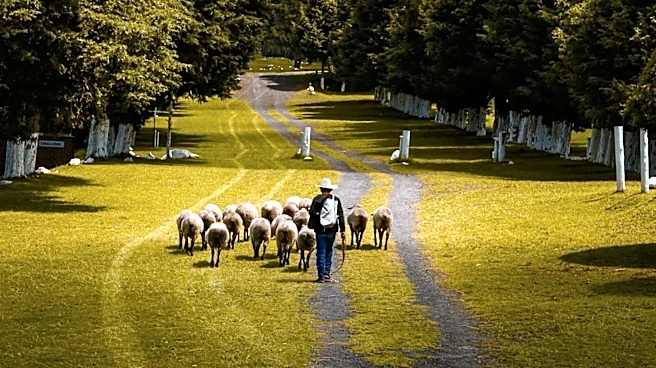
Johnny O’Mara, a first-generation shepherd in Mendocino County, Northern California, is promoting a philosophy of kinship with land and animals through his work and workshops. After years in large-scale grazing operations, O’Mara now tends a flock of 40
goats on his family property for sustenance and works as a freelance ranch hand. His primary focus is leading workshops on 'lost arts' such as animal processing, hide tanning, and felting. O'Mara emphasizes an animistic worldview, treating animals as subjects rather than objects, and aims to demystify the modern disconnect from food sources. He is also reintroducing ruminants into the woodland landscape to enhance biodiversity, improve grassland health, and mitigate wildfire risks, believing that healthy grasslands lead to healthy animals and people. His approach challenges the conventional understanding of food systems and land stewardship.
Why It's Important?
O'Mara's work highlights a growing movement in the U.S. towards sustainable agriculture and a deeper connection to food sources, which could influence local food economies and environmental conservation efforts. By teaching traditional animal husbandry skills, he addresses a gap in modern food systems, empowering individuals to understand and participate in the processing of their food. This initiative could foster greater ecological literacy and promote practices that reduce reliance on industrial agriculture. The emphasis on using grazing to increase biodiversity and reduce fire fuel is particularly relevant in California, a state frequently impacted by wildfires, offering a model for ecological restoration and risk management. His philosophy of stewardship, centered on creating conditions for more life, could inspire broader community engagement in environmental care.
Beyond the Headlines
O'Mara's philosophy extends beyond practical skills, touching on ethical and cultural dimensions of human-animal relationships. His animistic worldview, which sees animals as subjects, challenges the dominant Western paradigm that often objectifies animals in food production. This approach encourages a re-evaluation of our 'ancient agreement' with nature, prompting individuals to consider the unseen impacts of their consumption choices, such as the carbon footprint of industrial processes. The workshops serve as a 'rite of passage,' reclaiming a birthright to process animals for consumption, which can have profound psychological and cultural implications for participants. This movement could lead to a more conscious and reciprocal relationship with the environment, fostering a sense of indebtedness and community with the natural world, rather than just a transactional one.