








What's Happening?
Margie Hennesy, at 90 years old, has embarked on an intensive fitness journey, consistently lifting weights and training for her first Hyrox competition, a demanding fitness race combining running with functional workout stations. Just months after starting,
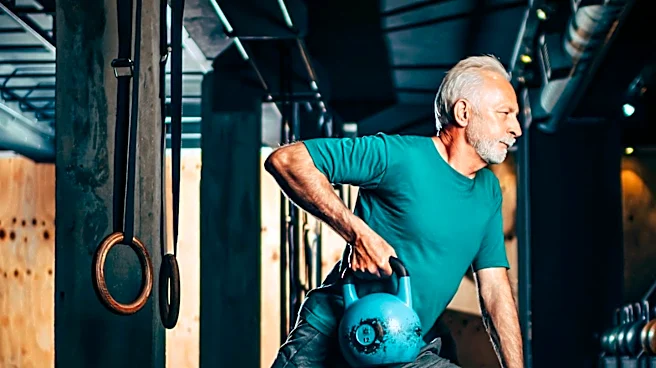
Hennesy can push a 200-pound sled and perform wall balls with a 10-pound ball. Her training regimen, guided by her daughter-in-law, involves three full-body strength and cardio sessions per week, each lasting 1 to 1.5 hours, focusing on Hyrox-specific exercises like ski ergs, sled pushes, and burpee broad jumps. On non-gym days, she walks four to eight miles and performs upper-body strength sessions at home. Hennesy's transformation began after her husband's passing, when she took on physically demanding household tasks, discovering a newfound sense of strength and independence.
Why It's Important?
Margie Hennesy's story is a powerful testament to the benefits of strength training and physical activity at any age, challenging conventional perceptions of aging and physical capability. Her achievements highlight that significant muscle growth and functional improvement are possible even in later life, a concept supported by scientific research on resistance training in older adults. This narrative can inspire countless individuals, particularly seniors, to engage in physical fitness, potentially leading to improved quality of life, reduced fall risk, and enhanced independence. From a public health perspective, it underscores the importance of promoting active aging initiatives and accessible fitness programs for older populations. Her journey also demonstrates the psychological benefits of setting and achieving challenging goals, fostering determination and self-awareness regardless of age.
What's Next?
Margie Hennesy is set to compete in the Hyrox course in Dallas in November, where she will put her months of hard work to the test. Her participation will likely draw significant attention, further amplifying her message that age is not a barrier to physical achievement. Beyond the competition, Hennesy plans to continue racing for at least another year, suggesting a sustained commitment to her fitness journey. Her story may also lead to increased interest in Hyrox competitions among older demographics and potentially inspire fitness organizations to develop more age-inclusive training programs. The scientific community may also find her case study valuable for further research into the physiological and psychological impacts of high-intensity training in nonagenarians.
Beyond the Headlines
Margie Hennesy's remarkable journey transcends mere physical accomplishment; it speaks to the profound human capacity for resilience, adaptation, and continuous self-improvement. Her decision to embrace a rigorous fitness challenge after experiencing personal loss illustrates how physical activity can serve as a powerful coping mechanism and a pathway to renewed purpose. This story challenges ageist stereotypes prevalent in society, demonstrating that older adults can not only maintain but significantly enhance their physical and mental faculties. It also highlights the critical role of social support, as her daughter-in-law's encouragement and coaching were instrumental in her progress. Hennesy's experience offers a compelling narrative about redefining what it means to age, advocating for a life of active engagement and challenging personal limits, rather than succumbing to societal expectations of decline.