





What's Happening?
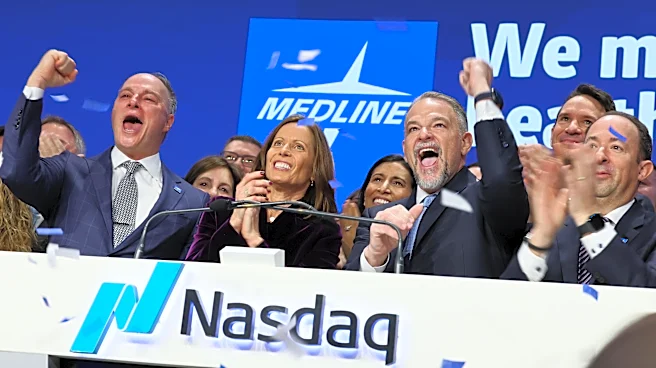
Nasdaq has achieved a record-breaking year in the U.S. IPO market for 2026, hosting the three largest initial public offerings in U.S. history. Companies like Anthropic, which raised $81.3 billion, and SpaceX, which raised $75 billion (rising to $85.7
billion), chose Nasdaq for their listings. Korean chipmaker SK hynix also raised $26.5 billion through its U.S. cross-listing on Nasdaq. This performance has allowed Nasdaq to secure five of the top ten largest U.S. IPOs ever, including the top three. The New York Stock Exchange (NYSE), traditionally the home for major debuts, did not secure any of these mega-IPOs. Nasdaq's success is partly attributed to a new 'fast entry' rule for its Nasdaq-100 index, implemented on May 1, which allows newly listed companies whose market value ranks among the top 40 index members to join after 15 trading days, significantly faster than the previous three-month waiting period.
Why It's Important?
Nasdaq's dominance in the 2026 IPO market signifies a significant shift in the landscape for major U.S. company listings, particularly for high-growth technology and deep-technology firms. The 'fast entry' rule for the Nasdaq-100 index is a critical factor, as index membership drives substantial passive investment. Funds tracking the Nasdaq-100 are compelled to buy shares of companies entering the index, providing a significant capital boost. This competitive advantage allows Nasdaq to attract trillion-dollar issuers, making its linked products more valuable and increasing its index revenue. The NYSE, by contrast, has seen its market share for new listings decline, raising concerns about its ability to attract future mega-IPOs and maintain its historical position as a premier listing venue. This shift impacts financial markets, investment strategies, and the competitive dynamics between major U.S. stock exchanges.
What's Next?
The rivalry between Nasdaq and NYSE is expected to intensify, with the NYSE actively pushing back against Nasdaq's rule changes, questioning their impact on market integrity. The NYSE has also expanded its presence, including renaming NYSE Chicago as NYSE Texas and hiring a former senior advisor to Governor Greg Abbott, indicating a focus on regional competition. Nasdaq, in turn, launched Nasdaq Texas as a dual-listing platform. The ongoing competition for listings, particularly from emerging AI and deep-technology companies like OpenAI and Anduril, will likely shape future market dynamics. The success of these exchanges will depend on their ability to offer attractive listing conditions, index access, and strong ties with issuers, potentially leading to further innovations or regulatory scrutiny regarding listing rules and market fairness.
Beyond the Headlines
The intense competition between Nasdaq and NYSE extends beyond direct listing fees, with the larger prize being long-term revenue from trading volume, market data, and the lucrative index business. Nasdaq's third-quarter results for 2026 showed a 39% increase in index revenue, highlighting the financial significance of attracting companies to its indexes. This battle also reflects a broader trend in the financial industry where exchanges are not just trading venues but also powerful platforms influencing investment flows through their index products. The strategic use of index rules, such as Nasdaq's 'fast entry,' raises questions about market structure and the potential for exchanges to leverage their index offerings to gain a competitive edge, potentially influencing how companies choose to go public and how investors allocate capital.