



What's Happening?
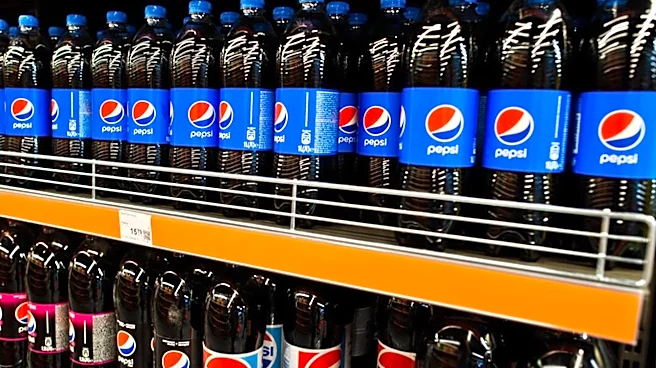
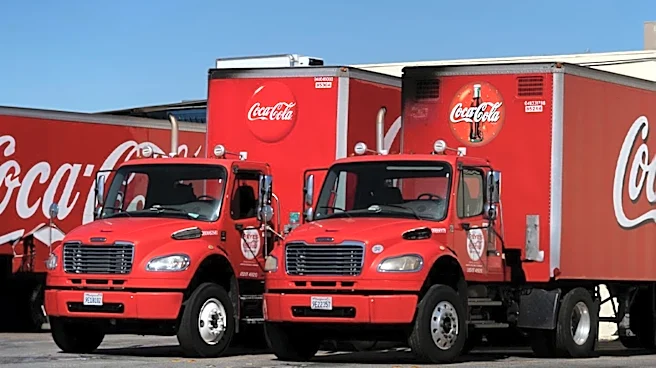
PepsiCo's revenue significantly surpasses that of Coca-Cola, nearly doubling it, yet Coca-Cola's stock has outperformed PepsiCo's over the past five years, gaining 97.7% compared to PepsiCo's 1.5%. This disparity is attributed to Coca-Cola's steadier
quarterly revenue progression, indicating stronger pricing power and operational efficiency. While PepsiCo generated $25.3 billion in revenue in Q3 2026, compared to Coca-Cola's $13.4 billion, Coca-Cola's operating margin was 33.4% in Q3, up from 32% last year, whereas PepsiCo's was 16.9%, an improvement from 14.9%. This difference stems from Coca-Cola's asset-light business model, primarily selling syrups and concentrates, while PepsiCo manages a more capital-intensive operation including manufacturing and delivery.
Why It's Important?
The stark contrast in stock performance despite PepsiCo's higher revenue highlights that top-line growth alone does not guarantee superior investor returns. Operating margin and business model efficiency are critical factors. Coca-Cola's asset-light approach allows for higher profitability per dollar of revenue and greater resilience to macroeconomic pressures, such as rising commodity costs. For PepsiCo, the challenge lies in optimizing its more complex operations to improve profitability and investor perception. Recent setbacks, such as KFC switching from Pepsi to Coke products and Marriott replacing PepsiCo as its exclusive global beverage provider, underscore the competitive pressures PepsiCo faces and the potential impact on its sales and market share.
What's Next?
PepsiCo has initiated a 'reset plan' focusing on sharper everyday value for snack brands, product line simplification, and plant closures, aiming to stimulate growth and improve profitability. The company also raised its fiscal 2026 net revenue growth forecast to 6.0% but cut its core earnings per share growth forecast to 3.0% due to rising commodity costs. Investors will closely monitor PepsiCo's operating margin in its next earnings report, expected in February 2027, to see if these strategic adjustments translate into improved financial performance. The market will also watch for any further account losses or gains in the highly competitive beverage sector, as these can significantly impact revenue and investor sentiment.
Beyond the Headlines
The differing trajectories of PepsiCo and Coca-Cola illustrate a fundamental divergence in business strategy within the consumer staples industry. Coca-Cola's focus on brand licensing and concentrate sales minimizes operational overhead, allowing for higher margins and potentially more stable earnings growth. PepsiCo, with its integrated food and beverage operations, faces the dual challenge of managing diverse supply chains and manufacturing processes while also innovating across a broader product range. The market's preference for Coca-Cola's model suggests a premium on efficiency and profitability, pushing PepsiCo to re-evaluate its operational structure and cost management. This competitive dynamic will likely drive continued strategic shifts and innovations across the entire food and beverage sector as companies strive to meet investor expectations and adapt to evolving market conditions.