






What's Happening?
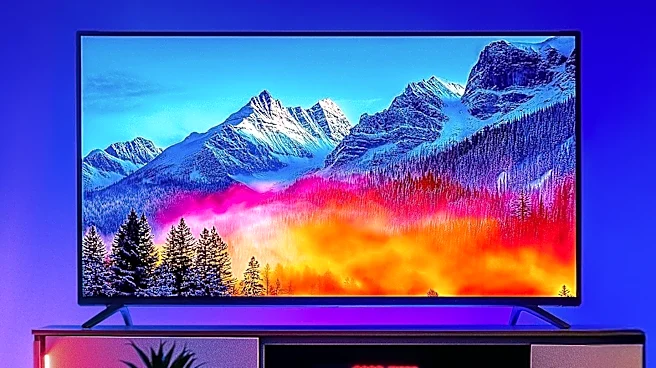
Initial enthusiasm for RGB LED television technology, sparked by impressive early models like the Hisense 116UX, has waned following extensive testing of several new RGB LED TVs, including the Hisense UR9, Samsung R95H, and Sony Bravia 9 II. While RGB LED TVs theoretically
offer superior brightness and color range, real-world viewing experiences reveal significant drawbacks. These issues include a compromise in color vividness to prevent 'color bloom'—a phenomenon where clashing hues can tint adjacent objects—and poor off-angle viewing, which leads to haze and desaturation. Unlike OLED TVs, which control light at the pixel level, RGB LED TVs rely on clusters of red, green, and blue LEDs for backlighting. This design, while promising in lab tests, struggles to maintain color accuracy and consistency in complex images, often defaulting to a neutral white backlight to avoid color distortion. This limitation means that the wide color ranges measured in controlled environments do not translate effectively to typical video content.
Why It's Important?
The findings are significant for the consumer electronics market and for consumers seeking high-quality television displays. The initial hype around RGB LED technology suggested it could surpass OLED in key performance metrics, potentially shifting market trends and investment. However, the identified limitations indicate that RGB LED, despite its theoretical advantages in brightness and color gamut, does not deliver a superior viewing experience compared to established technologies like OLED and even advanced mini-LED QLED. This reinforces OLED's position as the benchmark for premium picture quality due to its consistent color accuracy, perfect blacks, and excellent viewing angles. For manufacturers, this suggests a need to address fundamental issues with RGB LED implementation or to focus on refining existing technologies. For consumers, it provides clarity that, for now, OLED remains the best choice for a truly premium and immersive viewing experience, even if it doesn't always boast the highest peak brightness numbers.
What's Next?
Manufacturers of RGB LED TVs will likely need to innovate significantly to overcome the current limitations, particularly regarding color bloom prevention without sacrificing vividness and improving off-angle viewing performance. Research and development may focus on more sophisticated local dimming algorithms or alternative backlight architectures to better manage color consistency across diverse content. In the interim, the market is expected to continue favoring OLED for high-end consumers and advanced mini-LED QLED for those prioritizing extreme brightness. The competition between display technologies will drive further advancements, potentially leading to hybrid solutions or entirely new display types that combine the strengths of current technologies while mitigating their weaknesses. Consumers can anticipate continued improvements in both OLED and mini-LED QLED, with price points becoming more competitive as these technologies mature.
Beyond the Headlines
The challenges faced by RGB LED technology highlight a broader truth in technological innovation: theoretical superiority does not always translate to practical advantage. While lab tests can quantify specific metrics like brightness and color range, the subjective and complex nature of human visual perception often reveals nuances that raw data cannot capture. The 'color bloom' issue, for instance, underscores the intricate balance required in display engineering to render images faithfully. This situation also reflects the ongoing evolution of display technology, where each new iteration attempts to push boundaries but often encounters unforeseen hurdles. The continued dominance of OLED, despite its lower peak brightness compared to some LED counterparts, demonstrates that overall picture integrity, including contrast, viewing angles, and consistent color reproduction, often outweighs individual metrics in delivering a truly premium visual experience. This ongoing competition ultimately benefits consumers by driving continuous innovation and refinement across the display industry.