








What's Happening?
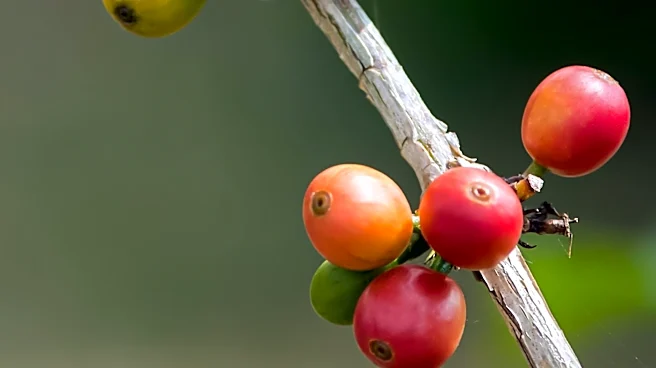
A new study published in the Wiley journal Sustainable Development challenges the long-held belief that robusta coffee is more resilient to climate change than other varieties. The lead author, Aaron Davis, a senior research leader at the Royal Botanic
Gardens, Kew, described this notion as an 'internet myth' stemming from flawed research. The study found that previous assessments overlooked robusta's intolerance to drought and other vulnerabilities. While robusta is more heat-tolerant than arabica, it is not drought-resistant. The paper indicates that major robusta-producing countries like Brazil, Vietnam, and India often rely on irrigation to ensure the crop's profitability, suggesting that these regions lack natural climate suitability for robusta without significant water management. This reassessment has significant implications for the coffee industry, which has increasingly looked to robusta as a solution for climate change adaptation.
Why It's Important?
This study is crucial for the global coffee industry, including U.S. businesses and consumers, as it directly impacts future supply chain strategies and pricing. If robusta is not as climate-resilient as previously thought, the industry's reliance on it as a buffer against climate change effects on arabica production may be misplaced. This could lead to increased volatility in coffee prices, affecting U.S. coffee retailers, roasters, and ultimately, consumers. Furthermore, it highlights the need for more accurate scientific research in agricultural planning and climate adaptation strategies. The findings could prompt a re-evaluation of investment in robusta cultivation in certain regions and encourage the exploration of other, genuinely resilient coffee varieties or more sustainable farming practices. For farmers, particularly in developing nations, this information is vital for making informed decisions about crop selection and resource management, potentially preventing significant economic losses.
What's Next?
The findings of this study are likely to spark further research into the climate resilience of various coffee species and varieties. Coffee producers, industry associations, and agricultural scientists will need to re-evaluate their long-term strategies for sustainable coffee production. This could involve increased investment in drought-resistant arabica varieties, the development of new hybrid strains, or the implementation of more advanced water management techniques in robusta-growing regions. Consumers in the U.S. might see shifts in coffee availability and pricing as the industry adapts. Policymakers and international organizations may also consider these findings when formulating agricultural aid and climate adaptation programs for coffee-producing countries. The study's author, Aaron Davis, emphasizes that the global coffee supply requires 'major structural and systemic change' to ensure its long-term survival, suggesting a comprehensive overhaul of current practices may be necessary.
Beyond the Headlines
This research uncovers a deeper issue within the agricultural sector: the potential for widespread misconceptions to influence global commodity markets and environmental strategies. The 'internet myth' surrounding robusta's resilience underscores the importance of rigorous scientific validation over anecdotal evidence or preliminary findings. Ethically, relying on flawed information can lead to unsustainable practices, misallocation of resources, and ultimately, exacerbate environmental challenges rather than mitigate them. The study also highlights the complex interplay between climate change, agricultural economics, and global trade. As climate patterns become more unpredictable, the need for accurate, data-driven agricultural science becomes paramount. This situation could serve as a case study for other agricultural sectors facing similar climate-related challenges, emphasizing the necessity of continuous research and adaptive strategies to ensure food security and economic stability worldwide.