
What's Happening?
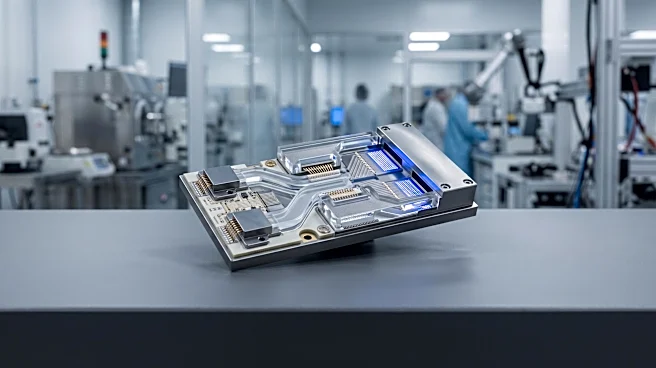
Avicena, a Sunnyvale-based startup, has successfully raised over $100 million in Series C funding to further develop its LightBundle platform, which utilizes microLEDs for optical interconnects between
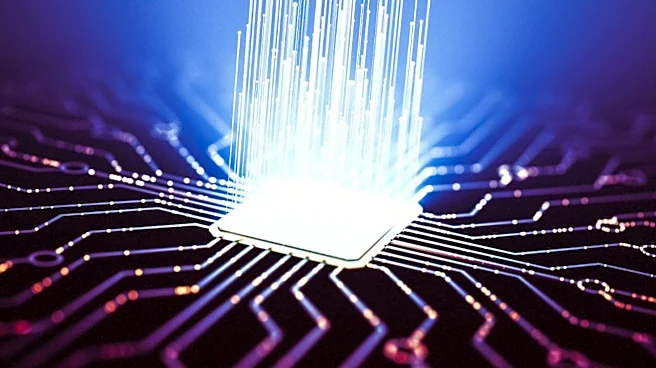
AI chips. This funding round was led by InterVest, with significant contributions from investors including Tiger Global, Cerberus Capital Management, SK hynix Ventures, Samsung Catalyst Fund, and AMD Ventures. Kevin Pope has been appointed as the new chief executive, succeeding Marco Chisari, and will lead the company as it prepares to launch its first product next year. The LightBundle platform aims to overcome the limitations of traditional copper links in AI systems, which face challenges in reach, density, and energy consumption when moving vast amounts of data between accelerators, memory, and switches. SK hynix Ventures has expressed interest in collaborating with Avicena on future memory interconnects, highlighting the growing importance of energy-efficient optical interconnects in next-generation memory architectures.
Why It's Important?
The development of Avicena's LightBundle platform is crucial for the advancement of AI infrastructure in the U.S. and globally. Current AI systems are increasingly constrained by the limitations of copper interconnects, which struggle with the massive data movement requirements between compute, memory, and networking chips. By offering an energy-efficient optical solution that uses microLEDs and multicore fiber, Avicena addresses these bottlenecks, potentially enabling faster and more powerful AI processing. This innovation could significantly impact U.S. technology companies and data centers that rely heavily on AI, allowing for more efficient scaling of AI capabilities. The investment from major players like SK hynix, Samsung, and AMD underscores the industry's recognition of the critical need for improved data transfer solutions in the AI sector. Successful deployment of this technology could lead to a competitive advantage for U.S. firms in AI development and application, while also reducing the energy footprint of large-scale AI operations.
What's Next?
Avicena plans to use the newly acquired funds for hiring, product development, and engineering as it moves towards bringing its first product to market next year. The company began shipping 1Tbps LightBundle evaluation kits in August and announced a version with connectors in September, indicating progress towards commercialization. The involvement of major chipmakers as investors suggests potential future collaborations and integration of Avicena's technology into their memory and compute solutions. The company's focus on a laser-free platform allows it to be positioned closer to compute and memory chips, which could simplify system design and improve performance. As AI continues to expand, the demand for efficient and scalable interconnect solutions will only grow, making Avicena's progress a key area to watch for advancements in AI hardware.
Beyond the Headlines
The shift from copper to optical interconnects, as championed by Avicena, represents a fundamental change in how data is moved within and between AI chips. This technological evolution has broader implications beyond just speed and energy efficiency. It could lead to new architectural designs for AI data centers, potentially enabling more compact and powerful systems. The ability to spread data across many slower channels, rather than pushing a few channels very fast, could also simplify data-rate conversion and complex signal processing, reducing the overall complexity and cost of AI hardware. Furthermore, the emphasis on energy efficiency aligns with growing environmental concerns and the push for more sustainable computing, which could influence future regulatory frameworks and industry standards for AI infrastructure. This development could also spur further innovation in related fields, such as advanced materials for optical components and new manufacturing processes for microLEDs.