







What's Happening?
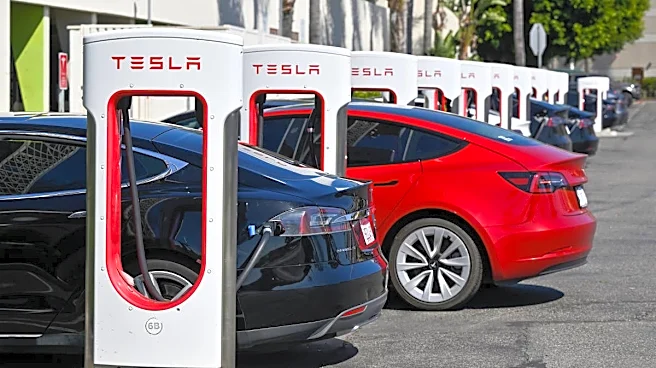
Tesla has reported a significant rebound in its automotive business, with vehicle deliveries exceeding expectations. Morgan Stanley has raised its forecasts for Tesla's vehicle deliveries in 2026 and 2027 to 1.67 million and 1.86 million, respectively.
The automotive segment remains a crucial revenue source for Tesla, accounting for about 70% of its income. This stability is essential as Tesla continues to invest heavily in AI infrastructure, including projects like Robotaxi and Optimus. Despite the automotive success, Morgan Stanley and Barclays maintain that Tesla's valuation is primarily driven by its AI and autonomous vehicle initiatives.
Why It's Important?
Tesla's improved automotive performance provides a stable financial foundation to support its ambitious AI and autonomous vehicle projects. The company's ability to generate revenue from its core business allows it to fund innovative technologies that could redefine transportation. This development is significant for investors and stakeholders, as it underscores Tesla's dual focus on maintaining a strong automotive business while advancing its AI capabilities. The success of Tesla's AI initiatives could have far-reaching implications for the automotive industry and the broader tech sector.
What's Next?
Tesla plans to expand its Robotaxi fleet, with expectations to reach 1,500 vehicles by the end of the year. The company is also exploring new markets for its autonomous services, including cities like Phoenix and Las Vegas. As Tesla continues to invest in AI and autonomous technology, stakeholders will be watching for tangible results and returns on these investments. The company's ability to balance its automotive and AI ambitions will be crucial in maintaining investor confidence and driving future growth.