






What's Happening?
The Boston University Track & Tennis Center (TTC), an 83,000 square-foot facility, has gained recognition for its state-of-the-art design and for hosting numerous record-breaking track and field performances. Opened in 2002 as part of the John Hancock
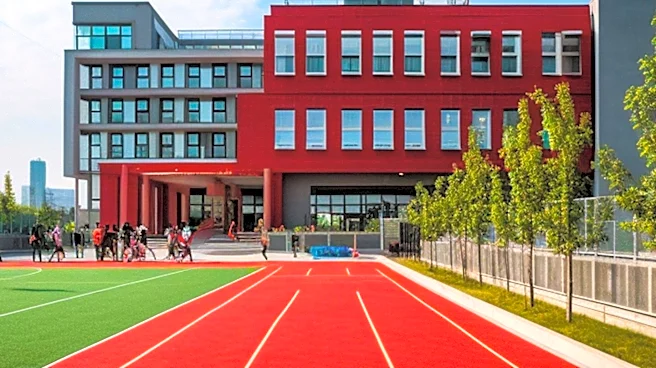
Student Village project, the TTC serves as the home for Boston University's men's and women's track and tennis teams. The facility features a 200-meter fixed bank oval track with a Rekortan surface, considered one of the finest track materials available, and an 18.5-degree banking designed to help runners maintain rhythm through turns. It also includes eight 60-meter sprint/hurdle lanes, long/triple jump runways, pole vault and high jump areas, and a throwing cage for shot put and hammer throw. The TTC has been the site of multiple world, American, Canadian, and Japanese national records in various distances, including the mile, 3000m, and 5000m. Notably, it holds the world record for the most sub-4:00 miles run at a single meet, with 52 in 2023. The facility also accommodates four full doubles tennis courts on its infield, separated by motorized netting, and is equipped with a Lynx timing system and a Daktronics track and field scoreboard.
Why It's Important?
The Boston University Track & Tennis Center's reputation as a 'fastest indoor track in the world' significantly impacts the U.S. collegiate and professional track and field landscape. By consistently hosting events where records are broken, the TTC attracts top-tier athletes and competitions, elevating the profile of Boston University's athletic programs and the city as a hub for elite track and field. This draws national and international attention, potentially increasing sports tourism and local economic activity through event attendance and related services. For athletes, competing at a facility known for speed offers a prime opportunity to achieve personal bests, qualify for higher-level competitions, and potentially secure sponsorships or professional contracts. The advanced design and materials of the track contribute to athlete safety and performance, setting a benchmark for other athletic facilities. Furthermore, the center's ability to host national championships and other significant events underscores its importance in the broader U.S. sports infrastructure, providing a crucial venue for the development and showcasing of athletic talent.
What's Next?
The Boston University Track & Tennis Center is expected to continue its role as a premier venue for indoor track and field events. Given its history of record-breaking performances, it will likely remain a favored location for athletes aiming to achieve fast times and for event organizers seeking to host high-profile competitions. The facility's ongoing maintenance and potential upgrades to its state-of-the-art equipment will be crucial to maintaining its reputation and attracting future events. Boston University will likely continue to leverage the TTC's prestige to recruit top student-athletes for its track and tennis programs. The success of the center could also inspire other universities and sports organizations to invest in similar high-quality athletic facilities, potentially leading to an overall improvement in U.S. indoor track and field infrastructure. Future events hosted at the TTC will continue to be closely watched by the athletic community for new records and competitive highlights.
Beyond the Headlines
Beyond its immediate impact on athletic performance, the Boston University Track & Tennis Center represents a significant investment in sports science and facility design. The 'tuned interface between structure and deck' and the Rekortan surface highlight the sophisticated engineering involved in creating optimal athletic environments. This focus on advanced materials and design not only enhances performance but also contributes to athlete well-being by potentially reducing injury risks and improving training efficacy. The center's dual functionality, accommodating both track and tennis, showcases efficient use of space and resources, a model that could be adopted by other institutions. Furthermore, the consistent breaking of records at the TTC contributes to the ongoing narrative of human athletic potential and the pursuit of excellence, inspiring future generations of athletes. The facility also serves as a community asset, providing a venue for various university functions and potentially fostering local engagement with sports.