
What's Happening?
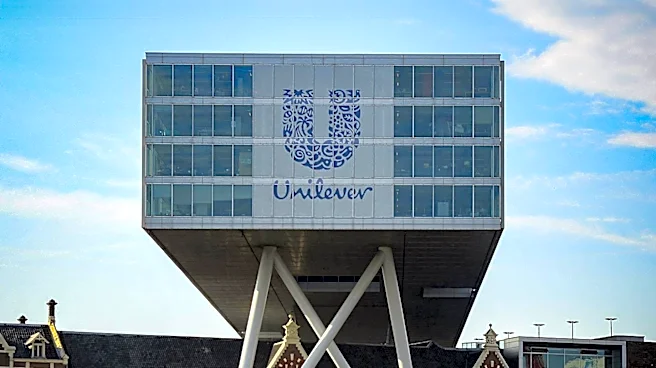
Unilever, a major consumer goods company known for brands like Dove and Hellmann's, has significantly reduced its UK TV advertising budget, reallocating funds towards online influencer marketing. This
strategic shift has particularly affected Channel 4, which has seen a 92% cut in Unilever's spending. Overall, Unilever's UK TV media spend has decreased by over 50% compared to the previous year. Other broadcasters, including Sky and ITV, have also experienced substantial reductions in Unilever's advertising investment, with declines of 44% and 42% respectively. This move aligns with Unilever CEO Fernando Fernandez's pledge to increase the company's reliance on influencers, expanding its creator network from 75,000 in 2024 to over 500,000. The company's Chief Marketing Officer, Leandro Barreto, stated that creator-led content delivers 1.5 times the return on investment compared to traditional branded content.
Why It's Important?
This shift by Unilever highlights a broader trend in the advertising industry, where major brands are increasingly moving away from traditional media channels like television in favor of digital and influencer marketing. For U.S. companies and advertisers, this signals a potential re-evaluation of marketing strategies and budget allocations. The success Unilever reports with influencer marketing could encourage other large corporations to follow suit, potentially leading to a decline in advertising revenue for U.S. television networks and print media. Conversely, it presents a significant opportunity for digital marketing agencies, social media platforms, and content creators in the U.S. to attract larger advertising budgets. The emphasis on measurable ROI from creator-led content also underscores a growing demand for data-driven marketing approaches, influencing how U.S. businesses measure campaign effectiveness and allocate resources.
What's Next?
The continued success of Unilever's influencer marketing strategy could accelerate a broader industry-wide shift in advertising spending, potentially impacting U.S. media landscapes. U.S. broadcasters and traditional media outlets may need to innovate their offerings and demonstrate competitive ROI to retain advertising dollars. Conversely, U.S. social media platforms and influencer networks are likely to see increased investment and demand for their services. The trend also suggests that U.S. marketing professionals will need to enhance their skills in digital content creation, influencer collaboration, and performance analytics. Furthermore, the use of AI tools, which Unilever has leveraged to produce more content at lower costs, indicates a future where technology plays an even more central role in optimizing marketing campaigns across various channels.
Beyond the Headlines
Unilever's pivot to influencer marketing raises deeper questions about the evolving nature of consumer engagement and brand authenticity. While traditional TV ads aim for broad reach, influencer marketing often targets niche audiences with seemingly more personalized content, potentially fostering stronger connections. However, research from Thinkbox, a UK marketing body, suggests that broadcast TV ads still generate significantly higher awareness uplift compared to influencers. This discrepancy highlights an ongoing debate within the advertising industry regarding the true impact and long-term effectiveness of different marketing channels. For U.S. consumers, this shift could mean a greater influx of sponsored content on social media, blurring the lines between organic content and advertising. Ethically, it also prompts discussions about transparency in influencer partnerships and the potential for undisclosed endorsements, which U.S. regulatory bodies like the FTC are actively monitoring.