







What's Happening?
Jamie Dimon, Chairman and CEO of JPMorgan Chase, addressed the Economic Club of Chicago, reflecting on his professional roots in the city and discussing current economic and geopolitical uncertainties. During his speech, Dimon touched upon the country's
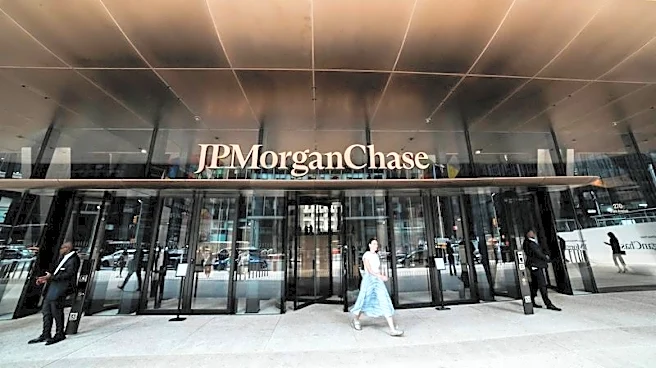
debt, ongoing conflicts in Ukraine and Iran, the threats posed by artificial intelligence, and shifts in the global geopolitical landscape. He also expressed a personal preference for Chicago over New York, eliciting a positive response from the audience. Dimon's visit included a tour of the renovated Chase Tower in the Loop, which is undergoing an $800 million multi-year renovation. This investment signifies JPMorgan Chase's long-term commitment to Chicago, where it employs approximately 15,000 people, with 7,200 based at Chase Tower. Dimon also reiterated the bank's policy requiring employees to be in the office five days a week since late 2025, emphasizing its importance for fostering relationships, speed, innovation, and the development of younger employees.
Why It's Important?
Jamie Dimon's remarks offer a significant perspective on the U.S. and global economic outlook from one of the nation's most influential bankers. His concerns about national debt, international conflicts, and AI's impact highlight key challenges that could affect economic stability and business operations in the coming years. JPMorgan Chase's substantial $800 million investment in renovating its Chicago tower underscores a broader trend among major corporations to reinvest in physical office spaces, despite the rise of remote work. This commitment to in-person work, as mandated by Dimon, reflects a belief that physical presence is crucial for corporate culture, mentorship, and innovation, potentially influencing other large employers' return-to-office strategies. The bank's philanthropic efforts in Chicago, totaling $214 million over the past decade, also demonstrate the role of major financial institutions in urban development and community support, particularly in underserved areas, aiming for sustainable economic growth rather than mere subsidies.
What's Next?
JPMorgan Chase's $800 million renovation of Chase Tower is expected to be completed in late 2027, which will likely further solidify the bank's presence and operational capacity in Chicago. The continued emphasis on a five-day in-office work policy by a major financial institution like JPMorgan Chase could influence other companies' decisions regarding remote work, potentially leading to more widespread mandates for in-person attendance, especially for younger employees. Dimon's ongoing commentary on economic and geopolitical issues will continue to be closely watched by investors, policymakers, and business leaders for insights into potential market shifts and strategic responses. The bank's philanthropic investments in Chicago are expected to continue, focusing on initiatives like affordable housing and workforce training, which could serve as a model for corporate social responsibility in other major U.S. cities.
Beyond the Headlines
Dimon's strong stance on in-office work, contrasting with the flexibility offered by many companies post-pandemic, raises deeper questions about the future of corporate culture and employee development. His argument that remote work leads to a 'decay in relationships, speed, and innovation' suggests a fundamental belief in the value of physical proximity for fostering collaboration and mentorship, particularly for new talent. This perspective could spark further debate on the long-term impacts of hybrid and remote models on productivity, employee well-being, and urban economies. Furthermore, Dimon's candid assessment of global uncertainties, including the 'shifting of tectonic plates' in geopolitics, highlights the increasing interconnectedness of financial markets with international stability. This suggests that businesses, especially large financial institutions, must increasingly integrate geopolitical analysis into their strategic planning, moving beyond purely economic indicators to assess risk and opportunity.