



What's Happening?
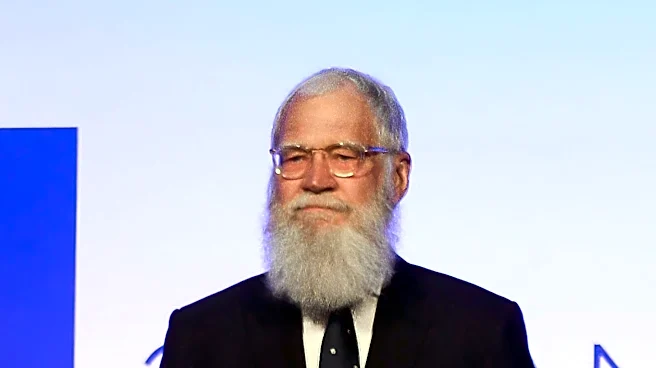
David Letterman's extensive career in talk shows began with guest-hosting 'The Tonight Show Starring Johnny Carson' 51 times between 1978 and 1982, which propelled him to national recognition. This led to his own shows, starting with 'Late Night with David Letterman' on NBC,
which aired from 1982 to 1993, featuring quirky comedy, celebrity interviews, and musical performances. He then moved to CBS to host 'Late Show with David Letterman' from 1993 to 2015, adopting a more traditional late-night format with monologues, sketches, and celebrity interviews. More recently, Letterman launched 'My Next Guest Needs No Introduction with David Letterman' on Netflix in 2018, an on-demand series focusing on in-depth, one-on-one interviews with prominent figures in various locations. His earliest show, 'The David Letterman Show' on NBC in 1980, though short-lived, earned two Daytime Emmy Awards and was instrumental in launching his career.
Why It's Important?
David Letterman's career trajectory illustrates the significant evolution of the late-night talk show format over several decades. His transition from network television to a streaming platform like Netflix reflects the broader changes in media consumption and production. Letterman's ability to adapt his style, from the offbeat humor of 'Late Night' to the more intimate, long-form interviews on Netflix, demonstrates the enduring appeal of the talk show genre when hosted by a compelling personality. His influence has shaped generations of comedians and hosts, setting benchmarks for wit, interviewing techniques, and audience engagement. The shift to streaming also highlights how traditional television personalities are finding new avenues to connect with audiences in the digital age, impacting viewership models and content distribution strategies.
What's Next?
With 'My Next Guest Needs No Introduction with David Letterman' continuing intermittently on Netflix, Letterman is likely to further explore the long-form interview format, potentially attracting new audiences who prefer on-demand, in-depth content over traditional weekly broadcasts. His continued presence on a global streaming platform suggests a sustained influence on the talk show landscape, potentially inspiring other veteran hosts to explore similar digital ventures. The success of his Netflix series could also encourage more streaming platforms to invest in personality-driven interview shows, further blurring the lines between traditional television and digital media. Letterman's legacy will continue to be studied as a case study in adaptability and longevity in the entertainment industry.
Beyond the Headlines
Letterman's career is a testament to the power of personality and adaptability in the entertainment industry. His journey from a daytime host to a late-night icon and now a streaming interviewer reflects not just personal evolution but also the changing nature of celebrity and media. The move to Netflix allows for a different kind of storytelling, free from the constraints of network television's commercial breaks and strict time slots, enabling deeper conversations. This shift also raises questions about the future of traditional late-night television, as audiences increasingly seek out content that offers more substance and less formulaic entertainment. Letterman's enduring appeal underscores a fundamental human desire for connection and authentic dialogue, regardless of the platform.