




What's Happening?
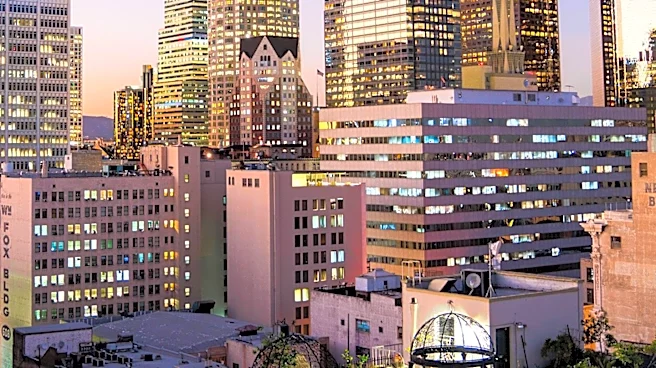
Real estate firms Jamison and Kennedy Wilson have partnered to address Los Angeles's affordable housing crisis by converting underutilized office towers into residential units. Their first joint project involves transforming the former L.A. World Trade
Center at 350 S. Figueroa St., a 400,000-square-foot office complex, into 'Sky Castle,' which will offer 512 affordable housing units. This initiative is part of a larger effort to create over 4,000 units through both adaptive reuse and new construction. According to Garrett Lee, chief executive of Jamison, the partnership aims to leverage the existing superstructure of office buildings, which makes conversions faster and more cost-effective than ground-up development. The project is significantly aided by Los Angeles's updated adaptive reuse ordinance, which streamlines the process for converting vacant buildings into housing. The firms plan to utilize the 4% federal Low-Income Housing Tax Credit (LIHTC) program to subsidize the construction of these low-income units, aiming for a simplified capital stack to keep building costs down.
Why It's Important?
This partnership represents a significant private sector response to Los Angeles's severe housing shortage, where the city needs approximately 450,000 new units by 2029 to meet state-mandated targets. The conversion of empty office spaces into affordable housing addresses multiple urban challenges simultaneously: it revitalizes underutilized commercial properties, provides much-needed housing, and contributes to urban sustainability by reusing existing structures. Nicholas Bridges, global head of capital markets at Kennedy Wilson, highlighted affordable housing as the 'great crisis facing Los Angeles.' The adaptive reuse approach is particularly important given the post-pandemic shift in work patterns, which has left many office buildings minimally used. By focusing on conversions, the firms can expedite development compared to new construction, which is often hampered by increased costs and high interest rates. This model could serve as a blueprint for other U.S. cities facing similar issues of office vacancies and housing scarcity.
What's Next?
The first phase of the L.A. World Trade Center conversion has already begun, aiming to create 241 affordable housing units, with a second phase adding 271 units. Jamison and Kennedy Wilson anticipate breaking ground on another 500 or more units within the next six months, primarily focusing on urban areas near jobs and public transit within Los Angeles, with plans to expand across the county. The joint venture has a pipeline of approximately 15 sites for future development. The success of these projects will largely depend on continued support from city ordinances and federal tax credit programs. The firms intend to hold onto these properties for an extended period, typically 18 years, to maximize the benefits from the Low-Income Housing Tax Credit program. This long-term commitment suggests a sustained effort to impact the affordable housing market in Los Angeles.
Beyond the Headlines
The trend of converting vacant office spaces into residential units, particularly affordable housing, signifies a broader shift in urban development strategies across the U.S. This approach not only addresses housing crises but also promotes environmental sustainability by reducing the need for new construction and minimizing urban sprawl. The Los Angeles Citywide Adaptive Reuse Ordinance, which went into effect in February, is a critical enabler, demonstrating how policy changes can unlock significant private investment in urban revitalization. This model also highlights the evolving nature of urban centers, adapting to new economic realities and work patterns. The ethical dimension of providing affordable housing is central, as it aims to improve the quality of life for a significant portion of the population. The long-term implications include potentially reshaping urban landscapes, fostering mixed-use neighborhoods, and creating more resilient cities that can adapt to future economic and social changes.