








What's Happening?
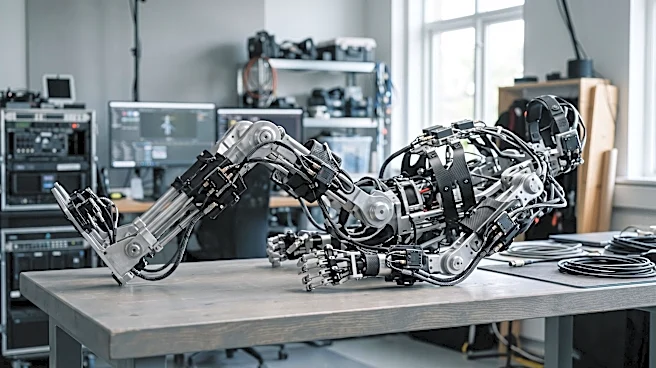
An interesting piece of animation history, a motion capture suit exoskeleton developed by Tippett Studio, is now available for auction. This device was designed to be worn by a performer for human motion capture, building upon the studio's earlier innovations
like the Dinosaur Input Device (DID). The DID was a dino-shaped sensor-covered armature created by Tippett Studio, ILM, and Pixar for 'Jurassic Park,' which translated stop-motion input to CG models. Following 'Jurassic Park,' Tippett Studio continued to develop encoder-covered capture devices for projects such as 'Starship Troopers.' The human motion capture exoskeleton, now up for auction with a starting bid of $1,000, became available after Tippett Studio closed its Berkeley studio. While the auction blurb mentions its use on 'Starship Troopers,' there's also speculation about its experimental use for 'Hollow Man.'
Why It's Important?
This auction represents a unique opportunity to acquire a tangible piece of cinematic and technological history, particularly for collectors, museums, or educational institutions focused on visual effects and animation. The exoskeleton highlights the early, innovative efforts in motion capture technology that paved the way for modern digital animation techniques. For the U.S. film industry, this artifact underscores the pioneering spirit of studios like Tippett Studio, ILM, and Pixar in pushing the boundaries of visual effects. It serves as a reminder of the foundational work that enabled the creation of iconic films and established the U.S. as a leader in special effects. The sale also reflects the evolving landscape of production studios, with the closure of Tippett Studio's Berkeley location marking a shift in the industry.
What's Next?
The auction of the motion capture exoskeleton will determine its next owner, potentially placing it in a private collection, a museum, or an academic setting where it can be preserved and studied. Its sale could also spark renewed interest in the history of motion capture technology and the contributions of early visual effects pioneers. For the broader animation and visual effects community, this event serves as a historical marker, prompting reflection on the rapid advancements in digital production tools. While the physical device is a relic, the principles and innovations it represents continue to influence contemporary motion capture and animation techniques, suggesting ongoing evolution in how digital characters and performances are created.
Beyond the Headlines
The auction of Tippett Studio's motion capture exoskeleton offers a deeper insight into the iterative and experimental nature of technological development in the film industry. It illustrates how early, often cumbersome, devices laid the groundwork for the sophisticated motion capture systems used today. This artifact embodies the transition from traditional animation methods to digital ones, showcasing the ingenuity required to bridge these two worlds. It also highlights the human element in technological innovation, as animators and engineers collaborated to create tools that could translate artistic vision into digital reality. The exoskeleton is not just a piece of equipment; it's a symbol of a pivotal era in visual effects, demonstrating the continuous quest for more realistic and expressive digital performances that continues to drive the industry.