







What's Happening?
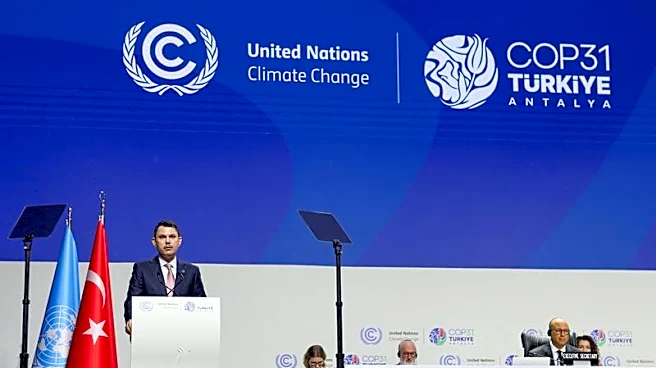
Over 180 companies, including major brands like H&M Group, Ikea, Danone, Uber, Schneider Electric, and Volvo Cars, have issued a statement calling on the COP31 presidency to accelerate the transition from fossil fuels to clean energy. Organized by the climate
nonprofit We Mean Business Coalition, the statement, released on November 3, emphasizes the need for governments to fast-track electrification and integrate it as a central pillar of economic and industrial strategy. The companies, collectively representing annual revenues of $1.69 trillion, highlight a significant gap between clean energy ambition and actual implementation. The COP31 summit, co-hosted by Turkey and Australia, aims for a '35x35' target, seeking to increase electricity's share of global final energy consumption from approximately 20% to 35% by 2035. Panels and discussions at the summit are focusing on collaborative efforts between governments, agencies, and industry to achieve this goal, particularly in emerging and developing economies.
Why It's Important?
This collective call from a substantial number of global companies underscores the growing private sector demand for decisive government action on climate change and clean energy. For the U.S., this initiative highlights a potential risk of losing momentum in electrification, as indicated by the Electrification Competitiveness Index. If major economies, including the U.S., fail to translate climate policies into actionable progress, businesses could face higher costs, delayed projects, and difficult decisions regarding capital allocation. The push for electrification is crucial for reducing reliance on fossil fuels, enhancing energy security, and mitigating volatile energy prices. The involvement of such a diverse group of companies signals a broad recognition within the business community that climate action is not just an environmental imperative but also an economic necessity, impacting competitiveness and investment landscapes globally.
What's Next?
The COP31 summit will continue to host discussions and negotiations aimed at developing strategies to accelerate electrification and achieve the '35x35' target. The We Mean Business Coalition's findings suggest that governments need to align their policies more closely with corporate ambitions to avoid hindering progress. Future actions will likely involve increased collaboration between the private sector and governments to overcome regulatory and infrastructural barriers to clean energy adoption. The outcomes of these discussions could influence national energy policies and investment decisions in the U.S. and other major economies, potentially leading to new incentives for clean energy development and infrastructure upgrades. The ongoing dialogue at COP31 will be critical in shaping the global energy transition roadmap.
Beyond the Headlines
The statement from over 180 companies reflects a deeper shift in corporate responsibility and strategic planning, where climate action is increasingly viewed as integral to long-term business viability and competitiveness. The 'electrification bottleneck' points to systemic challenges that extend beyond technological innovation, encompassing policy frameworks, financial mechanisms, and international cooperation. The emphasis on emerging and developing economies highlights the ethical dimension of climate justice, ensuring that the transition to clean energy is equitable and inclusive. This private sector advocacy could also influence consumer behavior and investor confidence, further pressuring governments to adopt more ambitious climate policies. The potential for the U.S. to lose momentum in electrification, as noted by the Electrification Competitiveness Index, suggests that domestic policy decisions will have significant global implications for climate leadership and economic standing.