






What's Happening?
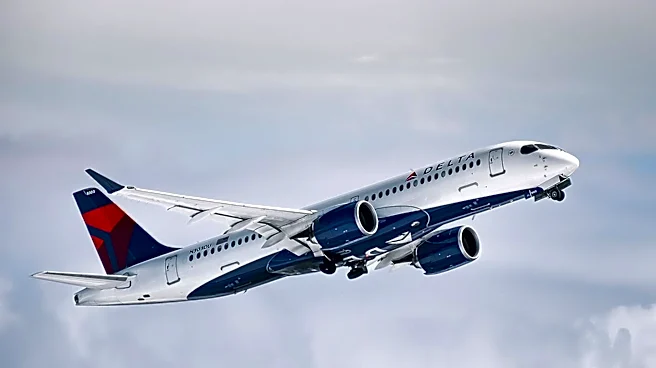
Delta Air Lines CEO Ed Bastian stated in a recent earnings call that consumers have shown 'limited amount of resistance' to increased airfares, still perceiving them as 'reasonably affordable.' This observation comes as jet fuel prices have reached record
highs, with the average price in the U.S. hitting $4.90 per gallon, more than double the price from a year ago. According to Hayley Berg, lead economist at Hopper, airfares for Thanksgiving are up approximately 30% compared to last year, and Christmas holiday tickets have risen over 20%. Despite these significant price increases, U.S. airlines report that demand remains steady. Bastian views this consumer behavior as a positive indicator for the future of the airline industry. While U.S. carriers are also affected by higher fuel costs, the situation may be slightly better than in Europe due to the U.S.'s greater oil-producing and refining capacity.
Why It's Important?
The sustained consumer demand for air travel despite rising costs has significant implications for the U.S. airline industry and the broader economy. For airlines, it suggests a strong pricing power, allowing them to pass on increased operational expenses, such as record jet fuel prices, to customers without a substantial drop in demand. This ability to maintain profitability in the face of higher input costs is crucial for the financial health of carriers like Delta. For consumers, it means that air travel, particularly during peak holiday seasons, will continue to be more expensive. This trend could lead to changes in travel planning, with more individuals booking earlier or seeking alternative transportation methods if prices become prohibitive. The resilience of travel demand also reflects underlying economic conditions, indicating that a segment of the population still has the disposable income and willingness to spend on leisure and essential travel, even at elevated prices.
What's Next?
Industry experts anticipate that airfares could continue to rise in the coming year, with some European airline CEOs predicting increases of 10-20%. While the U.S. market might experience a slightly less dramatic surge due to its domestic oil capacity, higher fuel costs are still expected to impact U.S. carriers. Consumers are already adapting by shopping around more for deals and booking tickets earlier to secure better prices. This trend of early booking, observed in September for holiday travel, is likely to continue. Airlines will likely monitor consumer resistance levels closely, adjusting pricing strategies to balance profitability with demand. The ongoing high demand, coupled with rising operational costs, suggests that the current elevated airfare environment is not a temporary anomaly but potentially a new normal for the foreseeable future, especially for popular travel periods.
Beyond the Headlines
The phenomenon of consumers accepting higher airfares with 'limited resistance' points to deeper shifts in consumer behavior and the perceived value of air travel. It suggests that for many, air travel has become an indispensable part of their lifestyle, whether for family visits, business, or leisure, making them less price-sensitive than in the past. This could also reflect a post-pandemic 'revenge travel' effect, where individuals are eager to travel and willing to pay a premium after periods of restriction. Furthermore, the airline industry's ability to maintain demand despite significant price hikes highlights a potential inelasticity in the market for certain travel segments. This could lead to long-term strategic adjustments by airlines, focusing on premium services and loyalty programs to capture and retain high-value customers, while potentially marginalizing budget-conscious travelers. The disparity in affordability could exacerbate social inequalities, making air travel less accessible for lower-income individuals and families.