



What's Happening?
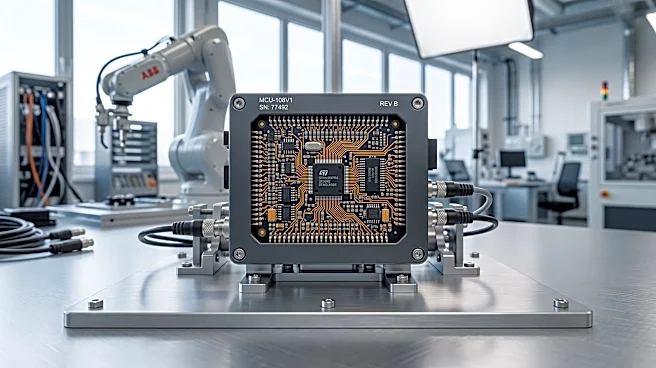
STMicroelectronics, a global semiconductor leader, has introduced its new STM32G5 series of mixed-signal microcontrollers (MCUs). These MCUs are designed to enhance efficiency, intelligence, and security in various advanced technology applications, including
AI datacenters, robotics, photovoltaic installations, wind turbines, industrial drives, and commercial drones. According to Patrick Aidoune, General Manager, General Purpose and Automotive Microcontrollers Division at STMicroelectronics, this new generation addresses the growing energy demands of AI datacenters and the need for more sophisticated robotic and motor-control systems. The STM32G5 MCUs are built with the Arm Cortex-M33 core, delivering twice the compute performance of the previous STM32G4 series. They also feature upgraded peripherals for improved speed and precision in controlling equipment like power supplies and electric motors. The single-core portfolio is expected to expand with dual-core products in 2027, offering even greater performance.
Why It's Important?
The introduction of the STM32G5 series is crucial for the advancement of physical AI, particularly in the U.S. technology and industrial sectors. These MCUs enable more efficient power management in AI datacenters, which are projected to demand over 2 GW of peak power by 2030. Even small efficiency gains can significantly reduce energy losses and cooling requirements, impacting operational costs and environmental sustainability for U.S. tech giants. In robotics, the enhanced performance and precision of the STM32G5 allow for the development of more dexterous humanoid robots, expanding their applications from factory automation to medical laboratories. This could lead to increased automation and productivity across various U.S. industries. Furthermore, the advanced security features, including Arm TrustZone IP and proprietary STM32Trust features, are vital for protecting sensitive data and ensuring compliance in critical applications.
What's Next?
The STM32G5 series is expected to drive further innovation in AI and automation. Developers will leverage these MCUs to create more advanced and energy-efficient solutions for datacenters and robotics. The planned expansion to dual-core products in 2027 suggests a continuous push for higher performance and more sophisticated applications. The dedicated ecosystems for digital power and motor control applications, including hardware, software, documentation, and training resources, will accelerate development and reduce time to market for U.S. companies. The integration of the STM32G5 series into the latest-generation STM32CubeMX2 development tool will streamline workflows and provide instant feedback, further aiding developers in bringing new products to market more quickly.
Beyond the Headlines
The STM32G5 series signifies a broader trend towards embedding AI capabilities directly into hardware, moving beyond cloud-based AI to 'physical AI.' This shift has profound implications for edge computing, enabling devices to process complex tasks locally with greater speed and security. The focus on energy efficiency in datacenters also highlights the growing environmental concerns associated with AI's increasing computational demands, pushing the industry towards more sustainable solutions. The advancements in robotics, particularly humanoid robotics, raise ethical considerations regarding the integration of advanced machines into daily life and the workforce. The robust security features are not just about data protection but also about ensuring the integrity and reliability of AI systems in critical infrastructure and sensitive applications, addressing potential vulnerabilities in an increasingly interconnected world.