





What's Happening?
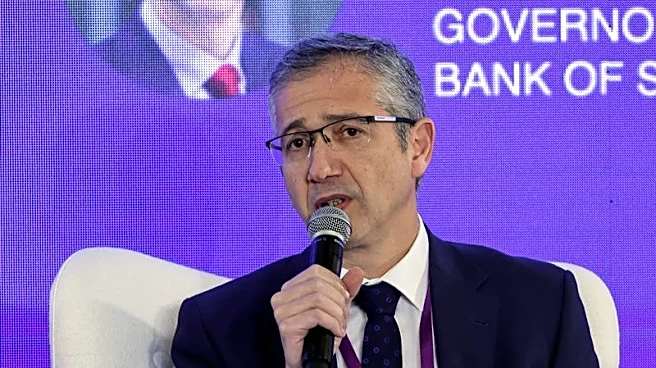
During the Jackson Hole symposium on August 28, 2026, Pablo Hernández de Cos, a candidate for the European Central Bank (ECB) presidency, voiced concerns regarding stablecoins. He stated that dollar-backed stablecoins are not a credible means of payment
at scale. De Cos highlighted that the widespread use of these tokens outside the United States could undermine other countries' control over their monetary policy, raising issues of sovereignty and control over payments. He also discussed limitations concerning conversions to central bank money and the need for controls against money laundering. De Cos, who was designated as a candidate for the ECB presidency on November 26, 2026, and previously chaired the Basel Committee, advocates for an approach that prioritizes tokenized bank deposits over private digital currencies like stablecoins and Bitcoin. This stance reflects a preference for leveraging existing financial infrastructures for monetary transformation.
Why It's Important?
De Cos's reservations about stablecoins are significant for the U.S. and global financial landscape, particularly given the U.S. dollar's role as the primary peg for many stablecoins. His concerns about the potential weakening of other countries' monetary policy control due to dollar-backed stablecoins underscore a growing international debate on digital currency sovereignty. If his views influence ECB policy, it could lead to stricter regulations or a less favorable environment for dollar-pegged stablecoins in Europe, potentially impacting their global adoption and the U.S. dollar's digital footprint. This perspective also highlights a broader trend among central banks to explore their own digital currencies (like the digital euro) and tokenized bank deposits as alternatives to privately issued stablecoins, aiming to maintain monetary control and financial stability. The emphasis on existing infrastructures suggests a cautious approach to innovation, prioritizing stability over rapid adoption of new, potentially disruptive technologies.
What's Next?
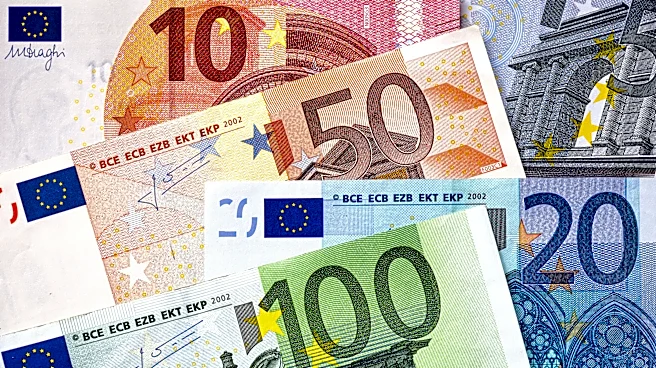
If Pablo Hernández de Cos is confirmed as the next ECB president, his stated preferences could significantly shape the future of digital payments and cryptocurrency regulation in Europe. His advocacy for tokenized bank deposits over stablecoins suggests that the ECB might focus on developing frameworks that integrate blockchain technology with traditional banking systems, rather than promoting private digital currencies. This could involve further development and potential issuance of a digital euro, with a pilot project planned for 2027 and possible issuance in 2029. Additionally, his past role as chair of the Basel Committee, which imposed a 1,250% risk weighting for direct bank holdings of Bitcoin, indicates a continued cautious approach to highly volatile digital assets. While the Basel Committee agreed to re-examine its framework for liquid digital assets by the end of 2025, a fundamental shift in doctrine regarding Bitcoin's risk assessment for banks is not immediately signaled.
Beyond the Headlines
The debate surrounding stablecoins, as articulated by Pablo Hernández de Cos, extends beyond mere financial innovation to touch upon fundamental questions of national sovereignty and economic control. The potential for dollar-backed stablecoins to diminish other nations' monetary policy autonomy raises geopolitical implications, suggesting a digital extension of currency hegemony. This could prompt a more aggressive push by various central banks to develop their own Central Bank Digital Currencies (CBDCs) to safeguard their financial independence and maintain control over their domestic payment systems. The preference for tokenized bank deposits also reflects a broader strategy to integrate technological advancements within existing regulatory and institutional frameworks, aiming for controlled evolution rather than disruptive transformation. This approach seeks to harness the benefits of blockchain technology, such as programmability and atomic settlements, while mitigating risks associated with unregulated private digital assets and preserving the stability of the traditional banking sector.