



What's Happening?
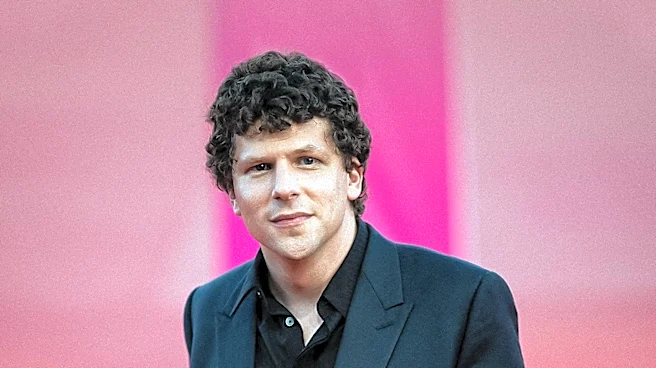
Actor Jesse Eisenberg recently shared with the New Yorker that he experiences minimal public interruption from fans, a phenomenon he attributes to the lack of sexuality in his on-screen work. Eisenberg stated that people are "mostly fine" when they encounter
him, often while he is writing scripts at a New York Public Library branch. He believes that once the public is encouraged to desire a performer sexually, that individual's life changes fundamentally. This perspective comes as Eisenberg promotes his latest directorial project, "The Debut." Despite his assertion, his "Fleishman Is in Trouble" co-star Claire Danes noted that people still recognize him, even though he aims for invisibility. Eisenberg also discussed his decision not to reprise his role in "The Social Reckoning," a follow-up to "The Social Network," due to uncomfortable fan interactions where individuals would comment on his portrayal of Facebook's founder.
Why It's Important?
Eisenberg's comments highlight a unique aspect of celebrity and public interaction, suggesting that the nature of an actor's roles can significantly influence their personal life and the way they are perceived by the public. His experience offers insight into the boundaries between an actor's professional persona and their private existence, particularly in an era where public figures often face intense scrutiny. The distinction he draws between roles that invite sexualization and those that do not could spark broader discussions within the entertainment industry about the impact of character portrayal on an actor's well-being and privacy. This perspective is particularly relevant for actors who navigate fame and public expectations, offering a potential framework for understanding varying levels of fan engagement and intrusion.
What's Next?
Eisenberg is currently promoting "The Debut," his third feature film as a director, which stars Julianne Moore and Paul Giamatti. The film, distributed by A24, is scheduled to open in theaters on December 11. His continued work as a writer-director, focusing on character-driven and unconventional stories, suggests a trajectory that prioritizes creative control and potentially reinforces his preference for roles that do not emphasize sexuality. The reception of "The Debut" and his future projects will further illustrate how his artistic choices align with his personal philosophy regarding public perception and the nature of his celebrity.
Beyond the Headlines
Eisenberg's reflections touch upon deeper societal implications regarding the objectification of public figures, particularly in the entertainment industry. His observation that a performer's life changes fundamentally when the public is encouraged to desire them sexually points to a broader issue of how media consumption can blur the lines between fictional characters and real individuals. This raises ethical questions about the responsibilities of casting directors, writers, and the media in shaping public perception and potentially contributing to the sexualization of actors. His commitment to creating "nonhierarchical" environments on his sets for films like "The Debut," which focuses on an underdog character, further underscores his awareness of power dynamics and the importance of respectful treatment, both on and off-screen.