




What's Happening?
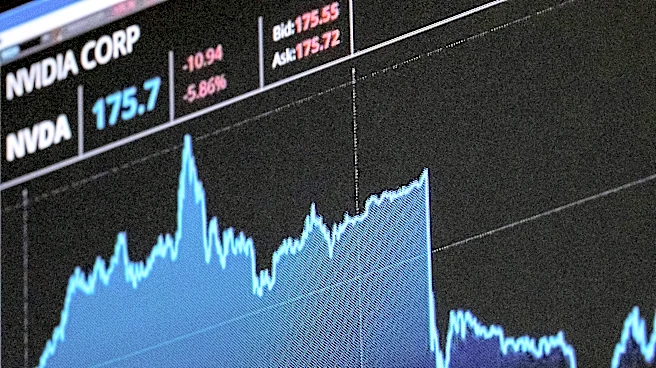
Nvidia is undergoing a significant leadership transition, with Jensen Huang no longer at the helm, leading to uncertainty in the private AI market. Harrison Rolfes, a PitchBook senior research analyst, highlights Nvidia's crucial role in the AI ecosystem,
serving as the largest corporate investor in U.S. AI, the primary supplier for AI startups, and a key benchmark for public stock investors evaluating the AI market. In 2026, Nvidia invested $189 billion in AI, with $172 billion allocated to major players like OpenAI, Anthropic, and xAI, and the remaining $17 billion distributed across 27 other deals. The new interim CEO, Colette Kress, is expected to approach dealmaking with more caution, potentially impacting companies heavily reliant on Nvidia's financial backing, particularly 'neoclouds' such as CoreWeave and Lambda Labs. This shift could lead to a reevaluation of AI valuations, which some venture capitalists believe were already inflated.
Why It's Important?
The change in Nvidia's leadership and its potential impact on investment strategies are critical for the U.S. AI industry. Nvidia's substantial financial contributions and its role as a technology provider have significantly shaped the growth and valuation of AI startups. A more conservative investment approach from Nvidia could lead to a slowdown in funding for emerging AI companies, particularly those in the early stages or those heavily dependent on Nvidia's infrastructure. This could result in a 'reset shakeout' in the market, potentially leading to more realistic valuations for AI companies. While some startups might face challenges in securing funding, a potential silver lining could be a decrease in GPU prices, making essential computing resources more accessible for other startups. This could foster innovation among seed-stage and Series A-stage companies that can now afford to build out their products more cost-effectively.
What's Next?
In the immediate future, AI startups are advised to temper expectations regarding investment from Nvidia. Instead of seeking direct funding, startups might find it more beneficial to focus on acquiring computing resources, such as cheaper chips, to develop their products. This strategic shift could lead to an influx of new seed-stage and Series A-stage startups entering the market, leveraging more affordable technology to innovate. The IPO of Anthropic is still anticipated, indicating that some high-stakes ventures will proceed despite the broader market adjustments. The long-term implications include a potential recalibration of AI valuations, which could lead to a healthier, more sustainable growth trajectory for the industry by weeding out less viable projects and encouraging more focused development.
Beyond the Headlines
The leadership change at Nvidia could trigger a broader re-evaluation of investment practices and valuation metrics within the AI sector. This development highlights the significant influence a single corporate entity can wield over an entire industry's financial landscape and innovation pace. The potential for a 'reset shakeout' could lead to a more disciplined investment environment, where capital is allocated to more robust and well-conceived AI projects. This could also prompt a shift in how startups strategize for growth, moving away from reliance on a single dominant investor and towards more diversified funding and resource acquisition. The ethical implications of such concentrated power in the hands of a few key players in a rapidly evolving technological field also warrant consideration, as changes in their strategy can have ripple effects across the entire ecosystem.