





What's Happening?
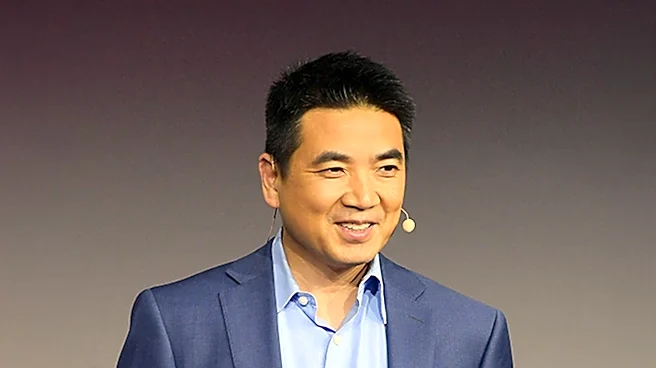
Zoom CEO Eric Yuan is among the notable investors in Genesis AI's recent Series A funding round, which successfully raised $500 million. This investment values Genesis AI at $3.5 billion and is aimed at advancing the development and deployment of its
general-purpose robot, Eno, into various workplaces. Genesis AI's technology focuses on enabling robots to learn physical tasks by observing human workers, who wear electronic gloves to capture their movements and convert them into training data. The company plans to use the new capital to expand robot training, enhance its artificial intelligence capabilities, and increase the production of Eno robots. Initial deployments of Eno are scheduled for 2027, targeting industrial environments such as manufacturing facilities, logistics operations, and laboratories. Genesis AI's mission is to create adaptable machines that can handle entire workflows, moving beyond robots programmed for single, repetitive tasks.
Why It's Important?
This significant investment in Genesis AI, backed by prominent tech leaders like Eric Yuan, underscores a growing confidence in the potential of AI-powered robotics to transform the U.S. workforce and economy. The development of robots like Eno, capable of learning complex physical tasks from human demonstration, could lead to increased productivity and efficiency across various industries. For businesses, this technology offers the prospect of automating physically demanding or repetitive jobs, potentially reducing operational costs and improving safety. However, it also raises critical questions about the future of employment, as robots capable of performing human tasks could impact job availability and require a re-evaluation of workforce skills. The ethical implications of workers training their potential robotic replacements are also a significant concern, highlighting the need for careful consideration of how these technologies will be integrated into society.
What's Next?
Genesis AI plans to begin deploying its Eno robots to customer sites in 2027, starting with industrial sectors. The company is also actively hiring researchers and robotics engineers to further develop its technology. A strategic partnership with LG CNS is in place to evaluate Genesis robots for manufacturing and logistics at LG operations in the United States, with potential expansion to other industrial clients. Following industrial deployments, Genesis AI intends to expand into hospitality and healthcare, with home robots and outdoor applications on its long-term roadmap. The company emphasizes that employee participation in training programs is voluntary and that no personally identifying information is collected. However, the long-term impact on employment and the need for businesses to address how these robots will integrate with human teams remain key areas for future discussion and policy development.
Beyond the Headlines
The rise of AI robots capable of learning and performing complex physical tasks introduces profound ethical and societal considerations beyond immediate economic impacts. The concept of workers inadvertently training their future robotic replacements raises questions about job security, fair compensation, and the moral responsibilities of companies developing and deploying such technologies. While Genesis AI states that participation in its training program is voluntary, the broader implications for the labor market and the potential for widespread job displacement warrant a proactive societal dialogue. Furthermore, the development of highly adaptable robots could lead to a redefinition of human work, emphasizing skills that robots cannot easily replicate, such as creativity, critical thinking, and complex problem-solving. This technological shift necessitates a re-evaluation of education systems and workforce training programs to prepare for a future where humans and advanced AI robots increasingly coexist in the workplace.