







What's Happening?
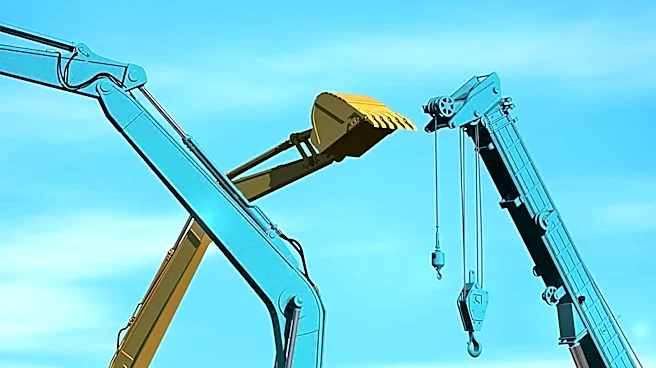
San Francisco-based Bedrock Robotics has deployed autonomous excavators on active commercial earthwork projects in Texas and Nevada, operating without human operators in the cabs. These deployments follow a year of testing with human supervision. The company's
'Bedrock Operator' system is designed as a retrofit for existing heavy equipment, allowing for sensor and computing packages to be installed within a day. Bedrock's machines are currently engaged in major infrastructure projects, including a Nevada water treatment facility with Sundt Construction and multimillion-cubic-yard earthwork projects with Champion Site Prep and Zachry Construction Corporation in Texas. The focus is on rough early earthmoving, clearing, cut-and-fill operations, and foundation preparation. Bedrock reports that the productivity of these autonomous excavators is nearing human levels, measured by cubic yards of earth moved per shift.
Why It's Important?
The deployment of autonomous excavators by Bedrock Robotics marks a significant advancement in the construction industry, offering a potential solution to the severe worker shortages faced by contractors in the U.S. With a substantial portion of the construction workforce nearing retirement and difficulties in filling skilled craft positions, automation could help maintain project timelines and reduce budget overruns. The technology aims to handle repetitive earthmoving tasks, freeing skilled operators to focus on more complex jobs or supervise multiple autonomous machines. This could lead to increased efficiency, faster project completion for housing, road infrastructure, and water facilities, and potentially improved safety by reducing human exposure to dangerous tasks. The investment of over $350 million in Bedrock Robotics highlights the industry's recognition of the transformative potential of this technology.
What's Next?
Bedrock Robotics plans to scale its excavator deployments and expand the types of tasks its autonomous system can perform. While current deployments involve new excavators outfitted at Bedrock's facilities, the company's long-term strategy includes retrofitting existing contractor equipment. Future developments aim for multiple autonomous machines to coordinate across a job site, with excavators working alongside bulldozers, trucks, and graders under a unified software system. This coordinated approach could significantly alter project scheduling and management. Bedrock emphasizes that its technology is intended to work alongside human crews, with experienced operators potentially transitioning into supervisory roles overseeing autonomous equipment. The company will continue to focus on safety, with machines automatically stopping if people or unauthorized objects enter their work zones, and human oversight remaining available for unusual situations.
Beyond the Headlines
The introduction of autonomous excavators raises broader questions about the future of work in the construction industry and the integration of AI into traditionally labor-intensive sectors. While Bedrock Robotics asserts that operators will not be replaced but rather transition to supervisory roles, the long-term impact on employment dynamics and skill requirements remains a critical consideration. The technology's success hinges not only on productivity and efficiency but also on its proven safety record in dynamic, human-populated construction environments. Ethical considerations around job displacement, the need for new training programs for a 'foreman for machines' role, and the legal frameworks for liability in autonomous operations will become increasingly prominent. This development could also accelerate the adoption of automation in other heavy industries, signaling a significant shift in how large-scale physical work is executed.