
What's Happening?
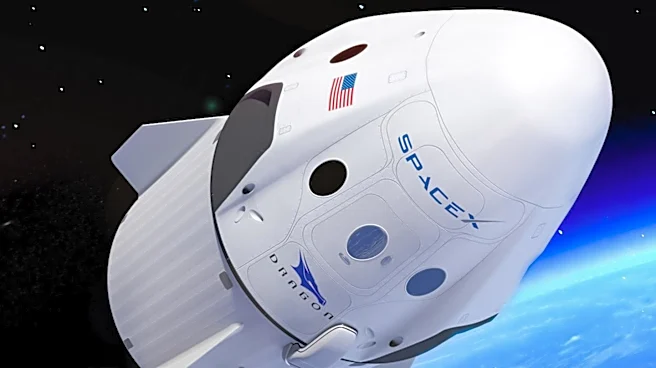
Axiom Space is a key player in commercial human spaceflight, primarily facilitating private orbital missions to the International Space Station (ISS) using SpaceX's Crew Dragon. These missions, which include
transportation, NASA-facility training, and a stay aboard the ISS, are priced around $55 million per seat for a 10-14 day flight. Beyond these orbital missions, Axiom Space is pursuing a larger strategy to develop its own commercial space station. This involves building modules designed to initially attach to the ISS and eventually operate independently. The company is also actively involved in developing advanced spacesuits for lunar and beyond-Moon missions, indicating a broader ambition in space exploration. Notably, several Axiom crews have included government-backed astronauts from countries aiming to establish their human-spaceflight presence, leveraging private operators as a service.
Why It's Important?
Axiom Space's initiatives are crucial for the evolution of the U.S. space industry, particularly in transitioning from government-led to commercial space operations. By brokering private missions to the ISS and developing its own commercial space station, Axiom is expanding access to space for a wider range of participants, including private citizens and international government-sponsored astronauts. This commercialization reduces the reliance on traditional government space agencies for routine access to low Earth orbit and fosters innovation in space infrastructure. The development of advanced spacesuits for lunar missions also positions Axiom as a significant contributor to future deep-space exploration, potentially supporting NASA's Artemis program and other international lunar endeavors. This shift creates new economic opportunities, drives technological advancements, and strengthens the U.S.'s leadership in the global space economy.
What's Next?
Axiom Space plans to continue its private orbital missions to the ISS, with the long-term goal of establishing its independent commercial space station. The modules currently being developed are intended to first integrate with the ISS before detaching to form a standalone orbital habitat. This transition is vital for the future of orbital tourism and research, as the ISS approaches the end of its operational life. The company's ongoing development of advanced spacesuits suggests future involvement in lunar missions, potentially in collaboration with NASA or other international partners. As commercial space stations come online, the economics of orbital tourism are expected to change significantly, allowing for a greater scale of private space travel beyond the limited capacity of the current ISS. Axiom's continued progress will likely shape the landscape of commercial space infrastructure and human deep-space exploration.
Beyond the Headlines
Axiom Space's efforts represent a fundamental shift in how humanity accesses and utilizes space. By creating a viable commercial pathway to orbit and beyond, the company is democratizing space travel and fostering a new era of space-based commerce and research. The development of private space stations could lead to unprecedented opportunities for scientific discovery, manufacturing in microgravity, and even space-based tourism, transforming space from a government-exclusive domain into a commercial frontier. This commercialization also raises important questions about space governance, resource allocation, and the long-term sustainability of human activities in space. Axiom's role in enabling government-backed astronauts from emerging spacefaring nations to participate in commercial missions further highlights the evolving geopolitical landscape of space, where private entities are increasingly becoming facilitators of international cooperation and competition.