





What's Happening?
The United States and Canada announced late Friday that trade negotiations have failed to reach an agreement. Consequently, Washington will implement 50% tariffs on certain Canadian imports. A senior U.S. administration official stated that these new
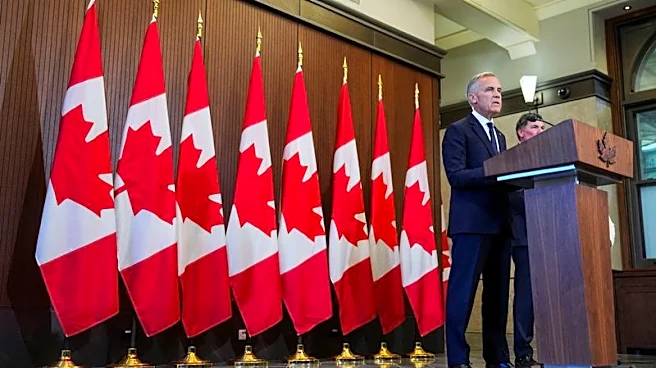
tariffs, which affect approximately $20 billion worth of imports, will take effect shortly after midnight on Saturday. In response, Canadian Prime Minister Mark Carney declared that he has suspended trade negotiations and recalled Canadian negotiators to Ottawa. Carney indicated that Canada plans to retaliate with equivalent measures, responding dollar-for-dollar to the new U.S. tariffs. This development marks a significant escalation in trade tensions between the two neighboring countries, following a period of intense but ultimately unsuccessful discussions aimed at resolving their commercial disputes. The immediate implementation of tariffs by the U.S. signals a firm stance from Washington, while Canada's pledge for reciprocal action suggests a looming trade conflict.
Why It's Important?
This imposition of tariffs by the U.S. on Canadian imports carries substantial economic implications for both nations. For American consumers and businesses, the tariffs could lead to increased costs for Canadian goods, potentially impacting supply chains and consumer prices. Industries heavily reliant on Canadian imports, such as automotive, lumber, or agriculture, may face higher operational expenses, which could be passed on to consumers or result in reduced profitability. Conversely, U.S. exporters could face retaliatory tariffs from Canada, making American products more expensive and less competitive in the Canadian market. This trade dispute could disrupt the long-standing economic relationship between the U.S. and Canada, two of the world's largest trading partners. It also signals a potential shift towards more protectionist trade policies, which could have broader implications for global trade relations and multilateral agreements. The dispute could also strain diplomatic ties, affecting cooperation on other bilateral and international issues.
What's Next?
Following the U.S. implementation of tariffs, Canada is expected to swiftly enact its promised retaliatory measures, imposing equivalent tariffs on U.S. imports. This tit-for-tat exchange could lead to a prolonged trade dispute, with both countries potentially escalating their actions. Businesses in both the U.S. and Canada will likely begin assessing the impact of these tariffs on their operations, supply chains, and pricing strategies. Consumers may see price increases on affected goods. Political leaders in both nations will face pressure to either de-escalate the situation through renewed negotiations or justify their protectionist stances. The broader international community will be watching closely, as such trade disputes between major economies can set precedents and influence global trade dynamics. There is a possibility of third-party mediation or intervention from international trade organizations, though immediate resolution appears unlikely given the current firm positions of both governments.
Beyond the Headlines
The breakdown in U.S.-Canada trade negotiations and the subsequent tariff imposition highlight deeper issues concerning national economic sovereignty and the future of global trade agreements. This event could signal a broader trend where traditional allies increasingly resort to protectionist measures to safeguard domestic industries, potentially undermining established trade frameworks like NAFTA/USMCA. The dispute also raises questions about the resilience of integrated supply chains and the vulnerability of economies to political disagreements. Ethically, the tariffs could disproportionately affect certain sectors or regions, leading to job losses or economic hardship for specific communities. Legally, the actions taken by both countries will be scrutinized under international trade laws, potentially leading to challenges at the World Trade Organization. Culturally, such disputes can foster nationalistic sentiments and strain the historically close relationship between the U.S. and Canada, impacting cross-border collaboration beyond just trade.