


What's Happening?
1X, a company specializing in humanoid robots, is facing scrutiny as its promised 2026 deliveries of the NEO robot to U.S. customers have not materialized as widely expected. Despite initial projections of tens of thousands of units being delivered this
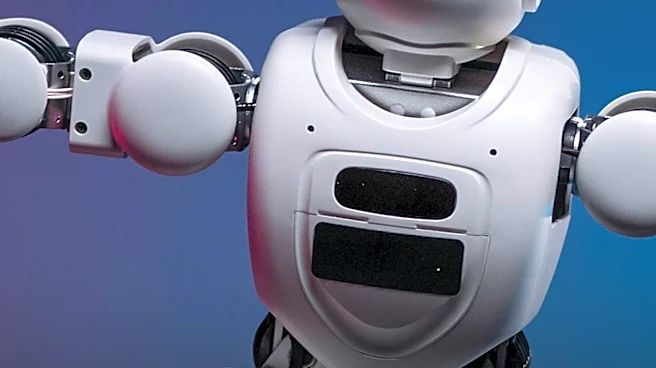
year, no paying customer has publicly confirmed receiving a NEO robot. The company admitted in April that its new factory was prioritizing research and employee homes for initial units, with some customers receiving their robots later. While the official delivery deadline for 2026 has not yet passed, the situation has shifted significantly from earlier announcements. The NEO robot, priced at approximately $18,400 or $460 per month, is designed with tendon-driven joints and a soft, mesh-covered body, capable of lifting over 150 pounds and carrying around 55 pounds. It operates at 22 decibels, quieter than a modern refrigerator, and is advertised to perform basic tasks like opening doors and turning off lights, with further functionalities expected through software updates. However, independent tests in October 2025 by Joanna Stern of the Wall Street Journal showed the robot primarily operating via teleoperation, with limited autonomous functions.
Why It's Important?
The delayed rollout of 1X's NEO humanoid robot has significant implications for the burgeoning U.S. robotics market and consumer expectations for advanced home automation. The discrepancy between initial promises of widespread deliveries and the current reality could impact investor confidence in the humanoid robotics sector, especially given the substantial pre-orders based on refundable deposits. For consumers, the reliance on an 'Expert Mode,' where a 1X employee remotely controls the robot via VR, raises concerns about privacy and the true level of autonomy. This model, while providing data for development, suggests that the technology is not yet as self-sufficient as marketed, potentially leading to user frustration and a slower adoption rate. The situation also highlights the challenges in scaling up production and ensuring the reliability and safety of complex robotic systems for household use, influencing how other companies in the U.S. approach similar product launches and manage public expectations.
What's Next?
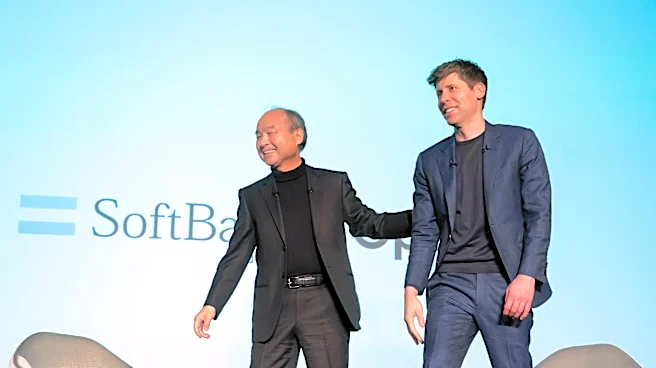
The immediate focus will be on whether 1X announces any deliveries to actual paying customers in the U.S. before the end of 2026, as per their order page. The company's next verifiable milestone is December 31, 2026, when the promised delivery window expires. Should 1X fail to announce a verified customer delivery, it could further erode trust and potentially lead to a wave of pre-order cancellations. Looking ahead, deliveries outside the U.S. are slated for 2027. The company's strategy of using remote human operators for tasks not yet mastered by the robot, while gathering real-world data, will continue to be a point of interest regarding privacy and the path to full autonomy. Furthermore, the financial stability of 1X, including potential acquisitions by entities like SoftBank and its existing agreements with EQT to deploy NEO in industrial settings, will influence its ability to overcome current production and delivery challenges and ultimately bring its humanoid robots to a broader market.
Beyond the Headlines
The challenges faced by 1X with its NEO robot underscore a broader ethical and practical debate within the U.S. and global robotics industry: the balance between technological ambition and real-world capability. The 'Expert Mode,' where human operators remotely control the robots, introduces complex questions about data privacy, surveillance, and the nature of human-robot interaction in domestic environments. While 1X states that sessions require user consent and include privacy measures like blurred faces, the concept of an external entity having direct visual access to a home raises significant concerns. This situation also highlights the 'AI washing' phenomenon, where advanced capabilities are promised but not yet fully realized, potentially leading to a trust deficit in emerging technologies. The long-term success of humanoid robots in U.S. homes will depend not only on their functional capabilities but also on transparent communication about their limitations and robust safeguards for user privacy and autonomy.