







What's Happening?
China's industrial firms experienced a slowdown in profit growth in July, with an 11.2% year-on-year increase, down from 15.1% in June. For the first seven months of the year, profits rose 17.6%, a decrease from 18.7% in the first half. This deceleration
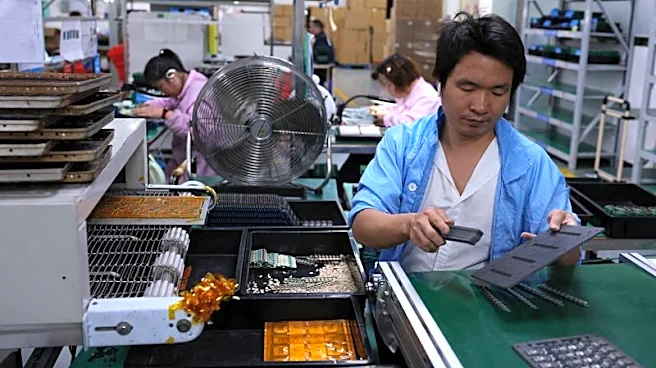
is primarily attributed to weakening domestic demand and external uncertainties, including trade tensions and geopolitical risks, which are pressuring margins and profitability. Despite the overall slowdown, export-linked, high-tech, and industrial sectors have shown strong performance. Notably, the computer, communication, and other electronic equipment manufacturing sector saw a 110% jump in profits, while non-ferrous metal smelting and rolling processing increased by 91.8% during the January to July period. Specific areas like fiber optics, optical cable manufacturing, and communication system equipment manufacturing recorded even higher growth rates. Conversely, consumer-facing and property-related industries continue to struggle due to subdued domestic demand, with China's largest liquor maker, Kweichow Moutai, reporting a 2% fall in net profit for the first half of the year.
Why It's Important?
The divergence in China's industrial profit growth highlights a critical split within its economy: robust performance in export-oriented, high-tech sectors, particularly those linked to the global artificial intelligence boom, versus persistent weakness in industries reliant on domestic consumption and the property market. This trend indicates that while certain segments of the Chinese economy are thriving due to global demand for advanced technology, the broader economic recovery is being hampered by internal factors. For U.S. businesses and policymakers, this situation presents a complex landscape. U.S. companies involved in the AI supply chain or high-tech manufacturing may find continued opportunities in China, benefiting from its export-driven growth in these areas. However, U.S. firms targeting the Chinese consumer market or those with exposure to its property sector might face ongoing challenges. The Chinese government's pledge for additional fiscal support underscores the severity of the domestic demand issue, suggesting potential policy interventions that could influence market dynamics and investment decisions for international stakeholders. The situation also reflects the broader impact of global economic conditions and geopolitical tensions on a major global economy.
What's Next?
In response to the economic slowdown and weakening domestic demand, China's vice finance minister has pledged to implement additional fiscal support measures in a timely manner. This indicates a proactive approach from Beijing to shore up growth and bolster confidence, particularly in sectors struggling with internal consumption. The nature and timing of these fiscal interventions will be crucial in determining their effectiveness in stimulating domestic demand and potentially narrowing the gap between the thriving export-oriented tech sectors and the struggling consumer-facing industries. Policymakers will likely focus on measures that can directly boost consumer spending and stabilize the property market. Businesses, both domestic and international, will be closely monitoring these policy announcements for potential opportunities or challenges. The ongoing divergence between strong external demand for AI-linked products and weak internal demand suggests that China's economic trajectory will continue to be characterized by this dual-speed growth, requiring targeted strategies from companies operating within or engaging with the Chinese market. The government's actions will also be watched for their impact on global supply chains and trade relations.
Beyond the Headlines
The pronounced divergence in China's industrial profit growth, where AI-linked and export-focused sectors flourish while domestic demand-driven industries falter, reveals a deeper structural shift within the Chinese economy. This isn't merely a cyclical downturn but potentially a reorientation of economic priorities and strengths. The emphasis on high-tech and export sectors, particularly those benefiting from the global artificial intelligence boom, suggests a strategic pivot towards advanced manufacturing and technological leadership. This could have long-term implications for global innovation and supply chains, as China solidifies its position in critical emerging technologies. Conversely, the persistent weakness in consumer-facing and property-related industries highlights the challenges in rebalancing the economy towards domestic consumption, a long-standing goal for Beijing. This imbalance could exacerbate social inequalities and create internal pressures, as job creation and wealth generation become concentrated in specific, high-skill sectors. The ethical dimension arises in how China manages this transition, ensuring that the benefits of technological advancement are broadly distributed and that the social safety net is robust enough to support those in traditional industries facing headwinds. The reliance on fiscal stimulus to address domestic demand issues also raises questions about long-term debt sustainability and the potential for market distortions.