


What's Happening?
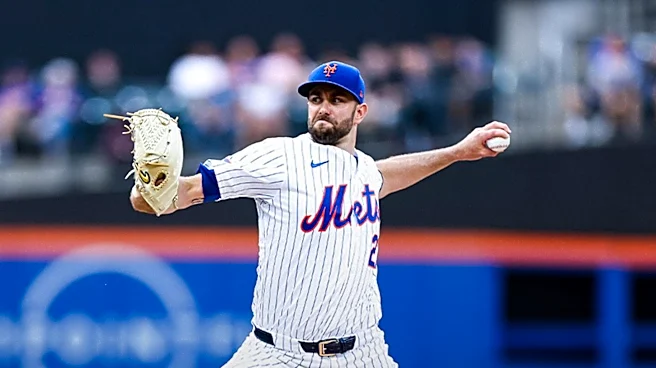
David Peterson, a free agent pitcher, is being considered a prime option to bolster the Cincinnati Reds' starting rotation. Peterson, a left-handed pitcher, concluded the 2026 season with the Chicago Cubs after being traded from the New York Mets on June
25. His performance significantly improved after joining the Cubs, where he posted a 3.70 ERA over 80⅓ innings. This turnaround followed a challenging start to the season with the Mets, where he recorded a 6.09 ERA over 68 innings across 16 appearances. The Cubs' intervention seemingly resolved issues Peterson faced, making him an attractive 'buy-low' option for teams like the Reds who are looking to add veteran savvy to their pitching staff. His ability to generate a high ground ball rate (50.1% in 2026 and 51.5% career) and limit home runs (0.90 HR/9 in 2026) is particularly appealing for a team playing in a home-run-friendly park like Great American Ball Park.
Why It's Important?
The potential acquisition of David Peterson is significant for the Cincinnati Reds as they face critical needs in their starting rotation for the upcoming season. With key pitchers like Hunter Greene sidelined due to injury and others struggling with consistency, the Reds are actively seeking reliable arms. Peterson's improved performance with the Cubs, characterized by a low hard-hit rate and effective ground ball generation, suggests he could be a valuable mid-rotation starter. His fit for Great American Ball Park, known for favoring home runs, is particularly crucial, as his pitching style is designed to mitigate long balls. This move could provide the Reds with a cost-effective solution, as his uneven year and a deep free-agent class might keep his contract demands manageable, projected around one-year, $10.1 million. Securing a pitcher with Peterson's specific attributes could stabilize the rotation and allow the team to allocate resources to other areas, impacting their overall competitiveness.
What's Next?
The Cincinnati Reds are expected to pursue David Peterson in the free agency market as they look to finalize their starting rotation. Peterson's contract negotiations will likely be influenced by the competitive landscape of free-agent pitchers and his recent performance trajectory. If signed, Peterson would join a rotation that currently includes Chase Burns, Andrew Abbott, and Nick Lodolo, with other young pitchers competing for remaining spots. His integration into the team would aim to provide a veteran presence and consistent performance, particularly in a ballpark that demands pitchers who can limit home runs. The Reds' ability to secure Peterson at a favorable price will be a key factor in their offseason strategy, potentially shaping their budget for other team needs and influencing their competitive outlook for the next MLB season.
Beyond the Headlines
The interest in David Peterson highlights a broader trend in MLB where teams seek to identify and acquire players who have shown significant improvement or adaptation, often after a change of scenery or coaching. Peterson's 'tale of two seasons' underscores the impact that team environment, coaching adjustments, and player development can have on an athlete's performance. For the Reds, this potential signing is not just about filling a roster spot but also about leveraging the 'fix' implemented by another team, the Cubs, to their advantage. This strategy reflects a sophisticated approach to player evaluation, focusing on underlying metrics and potential rather than just surface-level statistics. It also emphasizes the ongoing challenge for teams to find effective pitching solutions that align with their home ballpark's characteristics, especially in an era where offensive power is a dominant force in baseball.