




What's Happening?
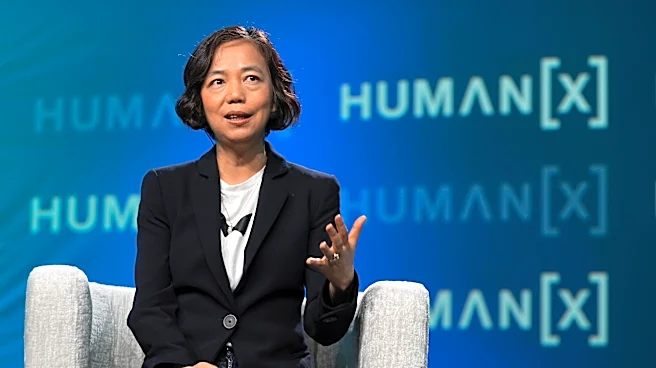
Fei-Fei Li, an artificial intelligence researcher and co-founder of World Labs, engaged in a public dialogue with Laurene Powell Jobs of Emerson Collective on November 16, 2026. The discussion centered on spatial intelligence and the ability of AI models
to understand and interact with the physical world. Li emphasized the importance of moving beyond text-based AI evaluation, advocating for machines to engage with visual and physical environments, drawing parallels to human development where perception precedes language. World Labs has introduced 'Atlas,' a tool designed to generate and explore 3D scenes, with related tools and development interfaces released on November 12, 2026. The core question raised is whether AI models capable of generating explorable scenes can reliably predict physical outcomes. The conversation highlighted that while AI can create and reconstruct environments, the reliability of these models for real-world applications, such as robot navigation, depends on rigorous testing and clear definitions of their capabilities and limitations.
Why It's Important?
This discussion is crucial for the advancement of artificial intelligence, particularly in the U.S. tech sector, as it addresses fundamental challenges in developing AI that can operate effectively in physical environments. Shifting the focus from purely linguistic AI to models that understand visual and physical interactions could unlock new applications in robotics, autonomous systems, and virtual reality. For industries relying on automation, such as manufacturing, logistics, and healthcare, the ability of AI to reliably predict physical outcomes is paramount for safety and efficiency. The emphasis on rigorous testing and transparent evaluation criteria, as advocated by Li, is vital for building trust in AI technologies and ensuring their responsible deployment. Without clear benchmarks and an understanding of AI's limitations, the integration of these advanced systems into critical infrastructure could face significant hurdles, impacting economic growth and public acceptance.
What's Next?
The ongoing development of tools like Atlas by World Labs suggests a continued push towards AI systems with enhanced spatial intelligence. Future efforts will likely focus on refining these models to improve their predictive accuracy and reliability in diverse physical scenarios. The call for clear evaluation metrics and a distinction between AI's generative capabilities and its understanding of physical laws will guide future research and development. Stakeholders, including AI developers, policymakers, and industry leaders, will need to collaborate on establishing standards for testing and deployment. This will involve defining acceptable risk levels for AI in physical applications and ensuring that the limitations of these technologies are transparently communicated. The dialogue also implies a need for continuous feedback loops, where real-world testing informs model improvements, moving beyond theoretical advancements to practical, verifiable applications.
Beyond the Headlines
The deeper implications of this discussion extend to the ethical and philosophical dimensions of AI. If AI can generate realistic physical environments and predict outcomes, it raises questions about the nature of 'understanding' in machines. The distinction between a model generating a plausible scene and truly comprehending the underlying physics is critical. This also touches upon the concept of 'explainable AI,' where systems must not only perform tasks but also provide insights into their decision-making processes, especially when operating in physical spaces where errors can have significant consequences. Furthermore, the integration of AI with physical world understanding could lead to a redefinition of human-machine collaboration, where AI acts as a more intuitive and capable partner in complex tasks, potentially transforming fields from scientific discovery to creative design. The challenge lies in ensuring that this technological evolution is guided by principles of safety, transparency, and human well-being.