






What's Happening?
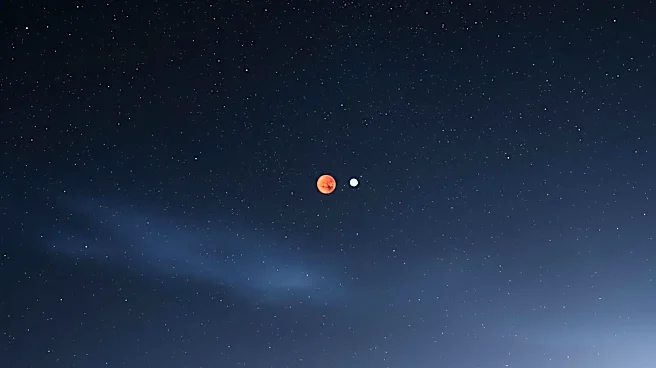
The astronomical events for the week of July 3 to 10, 2026, include a notable conjunction between Mars and Uranus. This celestial event occurs in the constellation Taurus, where Mars passes just 0.1° south of Uranus. The conjunction is best viewed in the early
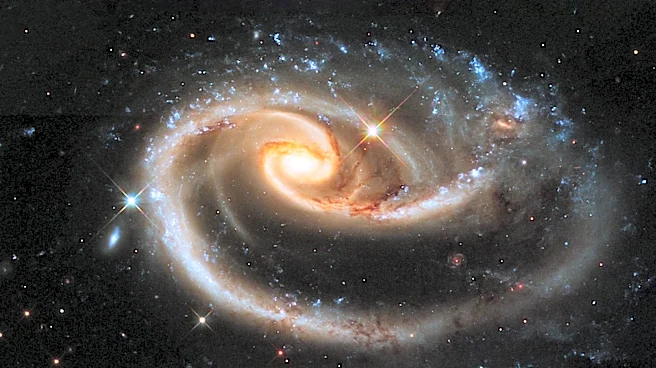
morning hours of July 4, with Mars visible to the naked eye and Uranus requiring optical aid due to its faintness. Additionally, the week features the Last Quarter Moon, multiple asteroids at opposition, and the Earth reaching its farthest point from the Sun, known as aphelion. The Fireworks Galaxy in Cygnus is also highlighted as a deep-sky object of interest, visible in the evening sky.
Why It's Important?
These astronomical events provide opportunities for both amateur and professional astronomers to observe and study celestial phenomena. The conjunction of Mars and Uranus is particularly significant as it allows for the observation of two planets in close proximity, offering insights into planetary motion and alignment. The visibility of the Fireworks Galaxy and other deep-sky objects enhances public interest in astronomy and encourages educational activities related to space science. Such events also contribute to ongoing research in astrophysics and the study of cosmic structures.
What's Next?
Following the conjunction, Mars and Uranus will gradually move apart, but both will remain visible in the night sky for some time. The upcoming weeks will continue to offer various astronomical events, including meteor showers and planetary alignments, which will be of interest to skywatchers. The continued observation of these events can provide valuable data for scientific research and public engagement in astronomy.