






What's Happening?
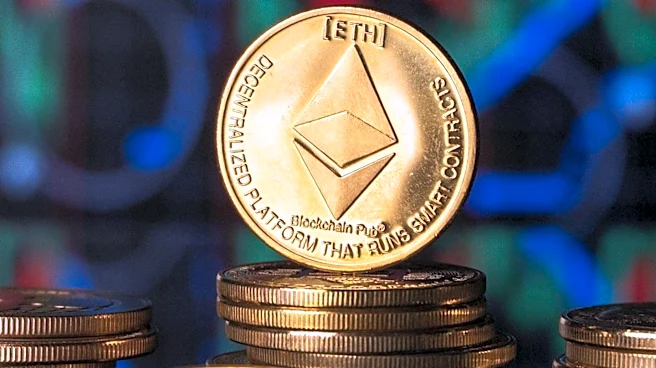
Individuals can now acquire Ethereum (ETH) directly online using credit or debit cards. This process involves selecting the desired amount of ETH, choosing a payment method, and completing any necessary identity verification. After reviewing the exchange
rate, fees, and the estimated amount of ETH to be received, the purchase is confirmed. Once the payment is processed, the purchased ETH is sent to the user's selected Ethereum wallet. This method allows for the acquisition of fractions of ETH, as the cryptocurrency is divisible to 18 decimal places, with purchases starting from $30. The availability of specific payment methods, such as bank transfers, depends on the user's location and the card issuer.
Why It's Important?
The increased accessibility of purchasing Ethereum with common payment methods like credit and debit cards simplifies entry into the cryptocurrency market for a broader audience. This ease of access can potentially drive wider adoption of Ethereum, impacting its market liquidity and overall valuation. For U.S. consumers, this means a more straightforward way to engage with decentralized finance (DeFi) applications, non-fungible tokens (NFTs), and other blockchain-based services that utilize ETH. The ability to buy fractions of ETH also lowers the barrier to entry for smaller investors, fostering greater participation in the digital asset ecosystem. This development could also influence traditional financial institutions to further explore integration with cryptocurrency services, given the growing demand and simplified purchasing processes.
What's Next?
Following the purchase, individuals have several options for their ETH. They can hold it in a self-custody wallet, secured by a recovery phrase, or send it to any Ethereum address on a supported network. Users can also connect their self-custody wallets to Ethereum applications to utilize their ETH on-chain, paying gas fees in ETH for transactions. Another option is to swap or sell the ETH for other supported cryptocurrencies or convert it back to local currency. Furthermore, ETH can be staked to help secure the Ethereum network, either by running a validator or through a third-party staking service, though the risks and withdrawal conditions vary depending on the staking method. Identity verification may be required for purchases, with requirements depending on the payment provider, transaction, payment method, and location.
Beyond the Headlines
The direct purchase of Ethereum with credit and debit cards highlights a broader trend towards the mainstream integration of cryptocurrencies into everyday financial transactions. This shift raises important considerations regarding regulatory frameworks, consumer protection, and financial literacy. As more individuals gain access to digital assets, there will be an increased need for clear guidelines on taxation, security, and fraud prevention. The irreversible nature of confirmed Ethereum transactions, contrasted with reversible card payments, underscores the importance of robust identity verification processes by payment providers. This evolution could also accelerate the development of user-friendly interfaces and educational resources to help new users navigate the complexities of blockchain technology and self-custody, fostering a more informed and secure digital asset environment.