

What's Happening?
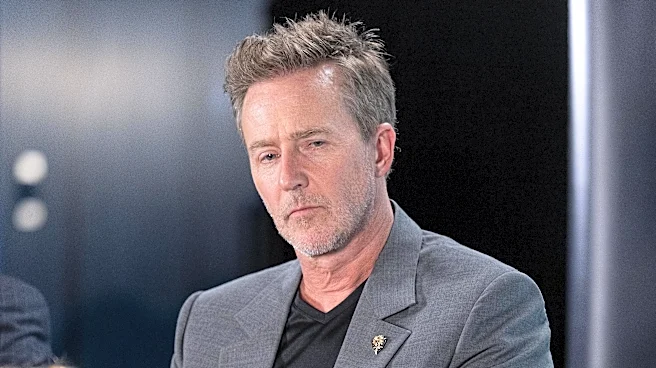
Edward Norton has voiced strong criticism regarding Hollywood's tendency to typecast actor Adam Sandler, arguing that the industry, including the Academy Awards, overlooks his dramatic talent. During a June 2026 appearance on the 'Fly on the Wall' podcast
with Dana Carvey and David Spade, Norton specifically highlighted Sandler's performance as Howard Ratner in the 2019 film 'Uncut Gems.' Despite critical acclaim for his portrayal of a New York Diamond District jeweler grappling with a gambling addiction, Sandler did not receive an Oscar nomination in 2020. Norton suggested that Hollywood is determined to keep Sandler confined to comedic roles, preventing recognition for his serious acting work. He described 'Uncut Gems' as one of his favorite films of the previous decade and praised Sandler's performance as among his finest. Norton also recalled Sandler's understated reaction to the lack of Oscar recognition, quoting him as saying, 'No love for the Sandman.'
Why It's Important?
This critique from Edward Norton underscores a broader issue within the entertainment industry concerning actor versatility and recognition. When established actors known for a particular genre, like comedy, venture into dramatic roles, they often face an uphill battle for critical acknowledgment, particularly from prestigious awards bodies like the Oscars. Norton's comments suggest that this typecasting can limit an actor's career trajectory and prevent audiences from seeing their full range of talent. For Adam Sandler, who has a long-standing career in comedy, the lack of an Oscar nomination for a performance widely praised for its dramatic depth highlights a potential bias within the Academy. This situation can influence how studios cast actors, potentially discouraging them from taking risks on performers outside their perceived 'box,' thereby limiting artistic expression and diversity in film roles.
What's Next?
While Edward Norton's comments bring attention to the issue of typecasting, it is unlikely to immediately alter the Academy's past decisions or significantly shift Hollywood's casting practices in the short term. However, such public statements from respected industry figures like Norton can contribute to ongoing discussions about artistic recognition and fairness in awards. It may encourage future critics and awards voters to more consciously evaluate performances without preconceived notions based on an actor's previous work. For Adam Sandler, this renewed discussion might further solidify his reputation as an actor capable of diverse roles, potentially influencing future casting opportunities in more dramatic projects. The conversation could also prompt other actors who feel typecast to speak out, fostering a broader dialogue about industry perceptions and the challenges of breaking free from established images.
Beyond the Headlines
The debate surrounding Adam Sandler's dramatic recognition extends beyond individual accolades, touching upon the cultural perception of comedy as a less 'serious' art form compared to drama. Often, comedic performances are undervalued in awards circuits, despite requiring immense skill, timing, and emotional intelligence. Norton's argument implicitly challenges this hierarchy, suggesting that a performer's comedic background should not disqualify them from being recognized for dramatic excellence. This issue also reflects on the power of audience expectations and brand identity in Hollywood; actors who build a strong brand in one genre can find it difficult to pivot, as both the industry and the public may resist seeing them in a different light. This resistance can stifle artistic growth and limit the potential for groundbreaking performances, ultimately narrowing the scope of cinematic storytelling.