





What's Happening?
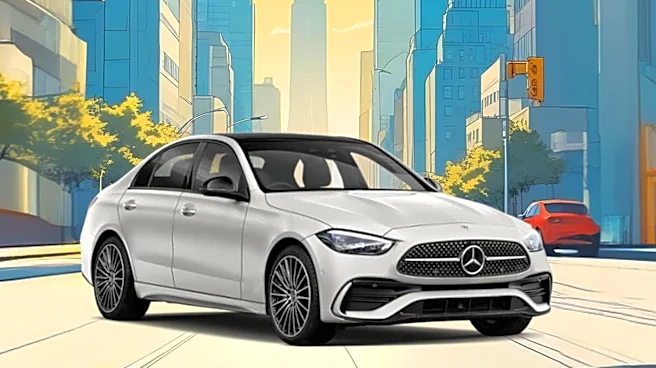
Mercedes-Benz has finalized a production agreement with Wayve, a London-based company, to integrate its AI Driver technology into future Mercedes vehicles within the next two years. This AI Driver will provide urban and motorway point-to-point driving
assistance. Mercedes-Benz had previously invested in Wayve’s $1.5 billion Series D funding round in February. The software has been successfully integrated into Mercedes' production architecture, utilizing the MB.OS operating system, Mercedes hardware, and map interfaces. Both companies emphasize that the system offers driving assistance, meaning the driver remains responsible for the vehicle's operation. Wayve's AI Driver is designed to learn without high-definition maps and trains on Nvidia infrastructure hosted on Microsoft Azure, allowing it to generalize to new cities without requiring geofences or local retraining. Demonstrations of the integration have been conducted in Stuttgart, London, and San Francisco.
Why It's Important?
This collaboration marks a significant step in the advancement of automotive artificial intelligence and driving assistance systems in the U.S. market. By integrating Wayve's AI Driver, Mercedes-Benz aims to enhance the safety and convenience of its vehicles, offering advanced point-to-point driving assistance in both urban and motorway environments. This technology could reduce driver fatigue and improve overall road safety by providing sophisticated support. The ability of Wayve's AI Driver to operate without HD maps and adapt to new cities quickly is a crucial innovation, potentially accelerating the deployment of advanced driving assistance features across a wider range of geographic locations in the U.S. The investment by Mercedes-Benz, alongside other major automotive players like Nissan and Stellantis, underscores the industry's commitment to developing and adopting AI-driven solutions for future mobility, impacting consumer expectations and the competitive landscape of the automotive sector.
What's Next?
Over the next two years, consumers in the U.S. can expect to see Wayve's AI Driver integrated into new Mercedes-Benz production vehicles, offering advanced driving assistance capabilities. This will likely set a new benchmark for what constitutes premium driving assistance in the automotive market. The continuous development and refinement of this AI technology, particularly its ability to generalize across diverse urban and motorway environments, will be a key focus. As the system is designed to scale from assistance to fully driverless products, future iterations could potentially offer higher levels of autonomy, pending regulatory approvals and further technological advancements. The success of this integration could also influence other automakers to pursue similar partnerships or develop their own AI-driven solutions, intensifying competition in the autonomous and assisted driving space.
Beyond the Headlines
The partnership between Mercedes-Benz and Wayve highlights a critical trend in the automotive industry: the increasing reliance on artificial intelligence for driving functions. While Mercedes already offers Drive Pilot, which allows for conditionally automated driving under specific conditions, Wayve's AI Driver focuses on broader point-to-point assistance, emphasizing the driver's continued responsibility. This distinction is crucial for understanding the current state and future trajectory of autonomous technology, where a phased approach to autonomy is being adopted. The use of AI that learns without HD maps and trains on cloud infrastructure signifies a move towards more adaptable and scalable solutions, potentially overcoming some of the infrastructure challenges associated with highly autonomous vehicles. This collaboration also underscores the global nature of technological innovation, with a British AI company partnering with a German automaker to impact the U.S. market, reflecting a cross-border exchange of expertise and investment in cutting-edge automotive technology.