


What's Happening?
Production designer Todd Fjelsted revealed that Netflix's upcoming series 'The Altruists,' which chronicles the story of crypto scammers Sam Bankman-Fried and Caroline Ellison, employed a 440-foot-long miniature marina to recreate the FTX headquarters
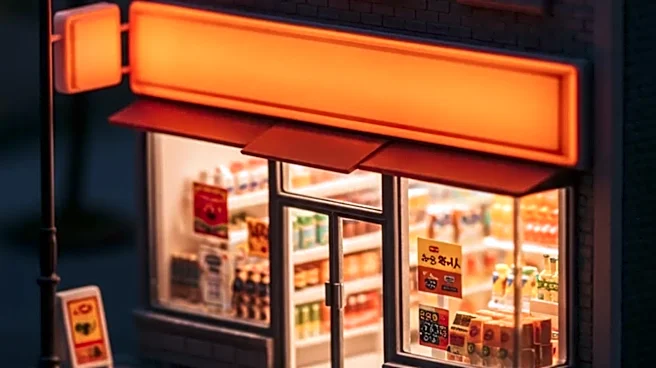
in the Bahamas. This elaborate set, which Fjelsted dubbed their 'anti-AI set,' wrapped around a two-story penthouse set and included nine 10-foot-tall apartment buildings, each with individual lighting and furniture. The decision to use miniatures was driven by the need to frequently feature the Bahamas penthouse in the series and the impracticality of filming on location or relying solely on visual effects. Fjelsted explained that this approach not only saved a significant amount of money compared to extensive visual effects but also provided a more immersive experience for the actors and crew, allowing for greater camera flexibility and a more realistic on-set environment.
Why It's Important?
The use of a large-scale miniature set for 'The Altruists' highlights a significant trend in the U.S. entertainment industry, particularly in television production, where traditional practical effects are being re-evaluated alongside advanced digital techniques. This approach demonstrates a strategic decision to balance cost-effectiveness with creative integrity, offering a tangible environment that can enhance actor performance and streamline production workflows. In an era increasingly dominated by CGI, the return to sophisticated miniature work suggests a recognition of its unique benefits, such as providing a more grounded visual aesthetic and potentially reducing post-production complexities. This could influence future production decisions across Hollywood, encouraging a hybrid approach that leverages the strengths of both practical and digital effects, ultimately impacting budgets, creative choices, and the visual quality of U.S. film and television content.
What's Next?
The success of the miniature marina in 'The Altruists' could lead to a resurgence of practical effects, particularly miniatures, in U.S. television and film production. Production designers and studios may increasingly explore hybrid approaches that combine physical sets with digital enhancements to achieve realistic and immersive environments more efficiently. This could foster innovation in model-making and set design, creating new opportunities for skilled artisans in the entertainment industry. Furthermore, the 'anti-AI set' label itself reflects a broader industry conversation about the role of artificial intelligence in creative processes, suggesting a potential pushback or at least a re-appreciation for human craftsmanship in visual storytelling. Future productions might highlight their use of practical effects as a unique selling point, appealing to audiences who value tangible artistry in filmmaking.
Beyond the Headlines
Beyond its practical benefits, the choice to use a miniature set for 'The Altruists' carries deeper implications for the art of filmmaking. It represents a philosophical stance against over-reliance on purely digital solutions, emphasizing the value of physical artistry and craftsmanship in creating believable worlds. This 'anti-AI' sentiment, as described by Fjelsted, taps into a broader cultural discussion about authenticity and the human element in creative endeavors, especially as AI technologies become more prevalent. The immersive experience for actors, as noted by Paul Reiser's reaction, underscores how practical sets can enhance performance by providing a more tangible reality to react to, potentially leading to more nuanced and compelling portrayals. This approach could also influence audience perception, fostering a greater appreciation for the intricate details and physical construction that contribute to cinematic realism, distinguishing productions that prioritize such craftsmanship.