






What's Happening?
ExxonMobil announced increased production in the Permian Basin, Guyana, and Golden Pass LNG near Sabine Pass, Texas, during its third-quarter operations report. These gains were partially offset by disruptions in output from the Middle East. According
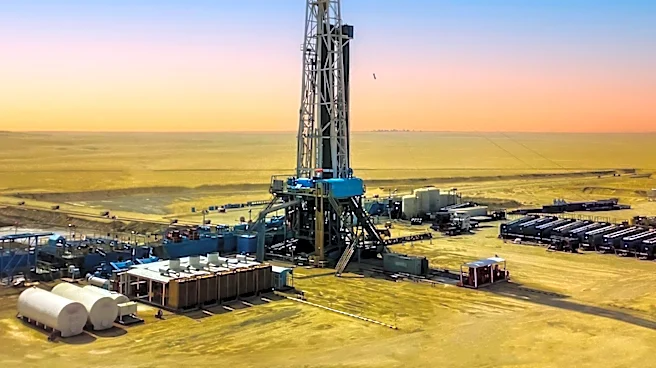
to Darren Woods, chairman and CEO, the company's third-quarter production reached 4,496,000 barrels of oil equivalent per day (boed), a slight decrease from 4,514,000 boed in the second quarter. Woods attributed the increased production and improved efficiency to years of consistent and disciplined investment and execution excellence. A key factor in the Permian Basin's performance is the deployment of automated drilling rigs, which are transforming operations by enhancing safety and efficiency.
Why It's Important?
ExxonMobil's continued growth in the Permian Basin, a critical U.S. oil-producing region, has significant implications for domestic energy supply and the broader U.S. economy. The adoption of automated drilling rigs signifies a technological shift in the oil and gas industry, promising safer and more efficient operations. This innovation can lead to lower production costs, increased output, and a more competitive U.S. energy market. For American consumers, a stable and robust domestic oil supply can contribute to more predictable fuel prices. The company's commitment to technology and efficiency also sets a benchmark for other industry players, potentially accelerating the adoption of advanced drilling techniques across the sector. Furthermore, the increased production supports energy independence goals and reduces reliance on foreign oil sources.
What's Next?
ExxonMobil plans to further increase its Permian production to approximately 2.5 million boed by 2030. This ambitious target suggests continued investment in advanced drilling technologies and infrastructure in the region. The company will likely expand its use of automated drilling rigs and other technological innovations to achieve these goals. Future reports will detail the progress towards this production target and the impact of ongoing technological advancements. The success of ExxonMobil's strategy in the Permian Basin could influence investment decisions and operational practices across the U.S. oil and gas industry, potentially leading to broader adoption of similar technologies and strategies.
Beyond the Headlines
The integration of automated drilling rigs in the Permian Basin by ExxonMobil represents a broader trend towards industrial automation and artificial intelligence in heavy industries. This shift not only promises operational efficiencies and safety improvements but also raises questions about the future workforce in the oil and gas sector. While automation can reduce human exposure to high-risk tasks, it may also alter job requirements, necessitating new skills and training for employees. The long-term implications include a more technologically advanced, data-driven energy industry, but also a need for strategic planning to manage the transition for human labor. This technological evolution could also influence environmental impact, as more precise and efficient drilling might reduce the footprint of operations.