


What's Happening?
The Grand Forks City Council has granted preliminary approval to extend a letter of intent agreement with Northern Plains Nitrogen (NPN) concerning industrial water supply and discharge for a proposed fertilizer plant. This extension will last from December
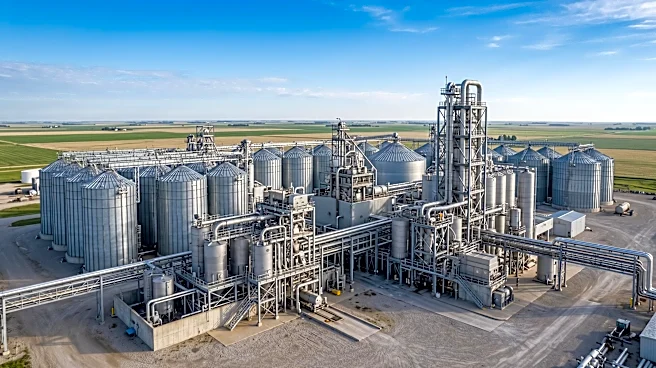
31st of the current year to December 31st of next year. NPN representatives provided an update to the City Council, indicating a goal to commence construction early next year and begin commercial operations by 2030. The estimated project cost has seen a slight reduction from $2.56 billion to $2.37 billion. The plant aims to produce approximately 1 million tons of granulated urea annually. Interest in the project has grown due to recent disruptions in fertilizer ingredient imports, leading the federal government to classify the demand for nitrogen fertilizer as a national security issue. NPN has reportedly raised $45 million in Schedule A shares and is seeking grants from the U.S. Department of Agriculture, though a previous application for the $500 million FIELDS program was not approved.
Why It's Important?
This development is significant for U.S. agricultural and economic stakeholders, particularly given the federal government's designation of nitrogen fertilizer demand as a national security issue. The U.S. currently imports 5 million of the 16 million tons of granulated urea it consumes annually, with North Dakota, South Dakota, and Minnesota alone accounting for roughly 3 million tons. A domestic production facility like the one proposed by NPN could substantially reduce reliance on foreign imports, enhancing national supply chain resilience and potentially stabilizing fertilizer prices for American farmers. The project's success would also bring considerable economic benefits to Grand Forks through job creation and increased industrial activity. However, the project's financing remains unconfirmed, and securing a project investor is a critical next step before a development agreement can be finalized, highlighting the financial challenges inherent in large-scale industrial ventures.
What's Next?
Northern Plains Nitrogen aims to reach a final investment decision by early next year, which is crucial for the project's progression. Following this, the company intends to begin construction early next year, with commercial operations targeted for 2030. City Administrator Todd Feland has stated that a development agreement between the city and NPN must be established before any site development can be approved. This agreement is contingent upon NPN securing a project investor. The extension of the letter of intent provides NPN with additional time to secure the necessary financing and finalize plans, indicating a continued commitment from both the company and the city to advance the project.
Beyond the Headlines
The push for domestic fertilizer production, exemplified by the Northern Plains Nitrogen project, reflects a broader national strategy to bolster critical supply chains and reduce vulnerability to global geopolitical events. The federal government's recognition of fertilizer as a national security issue underscores the interconnectedness of agriculture, economics, and national defense. This initiative could set a precedent for other essential industries to localize production, potentially leading to a re-evaluation of globalized supply chain models. The project also highlights the complex interplay between local government support, private investment, and federal policy in driving large-scale industrial development, with implications for environmental regulations, infrastructure demands, and community impact in regions hosting such facilities.