





What's Happening?
Anthropic, an AI safety and research company based in San Francisco, is actively recruiting a Research Engineer specializing in finetuning. The role focuses on improving the capabilities, reliability, and utility of its AI model, Claude, for complex,
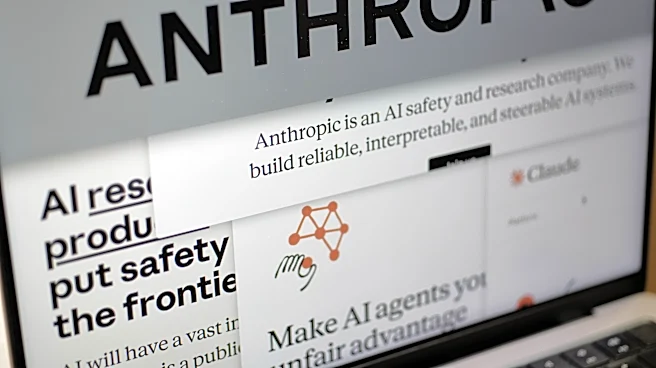
real-world applications. This position involves working across both research and engineering disciplines, from initial conceptualization and experimentation to implementing model enhancements. The company emphasizes a collaborative environment, viewing AI research as an empirical science akin to physics and biology. Key responsibilities for the Research Engineer include designing and executing experiments to boost model capabilities, developing reinforcement learning environments and evaluations, and building necessary tools and infrastructure. Anthropic's overarching mission is to create AI systems that are reliable, interpretable, and steerable, ensuring they are safe and beneficial for users and society. The company is a public benefit corporation and offers competitive compensation, benefits, and flexible working arrangements.
Why It's Important?
This recruitment highlights Anthropic's commitment to advancing AI safety and capability, which has significant implications for the broader U.S. technology landscape. By focusing on making AI systems like Claude more capable and reliable, Anthropic is contributing to the development of more trustworthy artificial intelligence. This is crucial for various sectors, including enterprise solutions, code generation, and AI assistant platforms, where the integrity and performance of AI are paramount. The emphasis on 'steerable' and 'interpretable' AI addresses growing concerns about AI ethics and control, potentially setting new industry standards for responsible AI development. The investment in such specialized research engineering roles underscores the competitive drive within the U.S. AI industry to push technological boundaries while simultaneously prioritizing safety and societal benefit. Success in these areas could lead to more widespread adoption of AI across industries, fostering innovation and economic growth, while mitigating potential risks.
What's Next?
The successful integration of a Research Engineer specializing in finetuning is expected to lead to tangible improvements in Anthropic's Claude model. These enhancements will likely manifest in more sophisticated AI applications, potentially expanding Claude's utility in various enterprise and consumer-facing products. The company's focus on empirical science and collaborative research suggests a continuous cycle of development and refinement, with new research directions emerging from ongoing experiments. As Anthropic continues to grow its team and advance its AI capabilities, it is likely to further influence the discourse around AI safety and ethical development. Future developments could include the release of more advanced versions of Claude, new AI tools, or research papers detailing breakthroughs in interpretability and steerability. This ongoing work will contribute to the evolving landscape of AI technology and its integration into daily life and business operations.
Beyond the Headlines
Anthropic's dedication to building 'reliable, interpretable, and steerable AI systems' goes beyond mere technological advancement; it addresses fundamental ethical and societal challenges posed by artificial intelligence. The company's public benefit corporation status and its mission to ensure AI is 'safe and beneficial for our users and for society as a whole' reflect a growing awareness within the tech industry of the profound impact AI can have. This approach suggests a long-term vision where AI development is not solely driven by commercial interests but also by a commitment to responsible innovation. The emphasis on interpretability, for instance, is crucial for fostering public trust in AI, allowing users to understand how AI systems make decisions. This ethical framework could influence regulatory discussions and public policy debates in the U.S. regarding AI governance, potentially shaping future standards for AI development and deployment across the nation.