





What's Happening?
Canadian mining company ValOre Metals has agreed to acquire all shares of Bemisa Água Azul Mineração, the owner of the Água Azul Gold Project in southeastern Pará State, Brazil, for a total purchase price of $135 million. The agreement was made with Opportunity
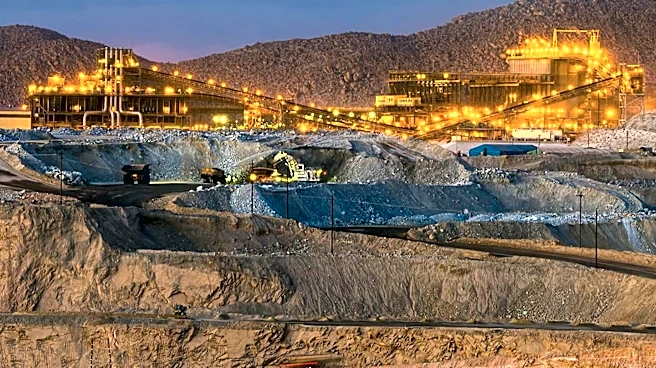
Holding Fundo de Investimento em Participações Multiestratégia. The Água Azul project is an active gold operation with existing mining and processing infrastructure, covering approximately 20,600 hectares in the Carajás Mineral Province. The transaction terms include an upfront payment of $90 million at closing, followed by $20 million on the first anniversary and $25 million on the second anniversary. ValOre has the option to prepay all deferred amounts for $30 million within four months after closing, subject to U.S. inflation adjustments. The acquisition is subject to approval by the TSX Venture Exchange and is expected to close on or before January 15, 2027. ValOre CEO and director Nick Smart stated that this acquisition represents a significant step towards becoming a precious metals producer of scale, adding a cash-generating, open-pit gold operation with plans to expand production to over 100,000 ounces of gold per year.
Why It's Important?
This acquisition signifies ValOre Metals' strategic expansion into the gold production sector, particularly in a Tier-1 mining region like the Carajás Mineral Province in Brazil. For the U.S. market, increased gold production from a Canadian company could influence global gold supply and pricing, potentially affecting investment strategies and the value of gold-backed assets. The Carajás Mineral Province is known for its rich mineral deposits, and a successful expansion of the Água Azul project could attract further foreign investment into the region, impacting the broader mining industry. The deal also highlights the ongoing trend of consolidation within the mining sector as companies seek to secure and expand their resource bases. The potential for increased gold output could also provide a more stable supply chain for industries that rely on gold, such as electronics and jewelry, although the direct impact on U.S. consumers would likely be indirect through global market dynamics.
What's Next?
ValOre Metals is currently in discussions to secure financing for the acquisition and ongoing operational costs of the Água Azul Gold Project. The closing of the transaction is contingent on approval from the TSX Venture Exchange, anticipated by January 15, 2027. Following the acquisition, ValOre plans to expand the project's capacity, with the Abelhas deposit currently operating an open-pit mine and processing plant at 120,000 tonnes per year, with plans to increase to a permitted 200,000 tonnes per year and a proposed 2.85 million tonnes per year, pending further permits. An independent mineral resource estimate from July 28, 2026, indicates significant gold reserves, and a preliminary economic assessment projects an average annual production of approximately 110,000 ounces of gold during Phase 2 of the operation. The company will focus on integrating the new asset and scaling up production to achieve its goal of becoming a major precious metals producer.
Beyond the Headlines
The acquisition of the Água Azul Gold Project by ValOre Metals underscores a broader strategic shift in the mining industry towards securing high-quality, cash-generating assets in politically stable and resource-rich regions. This move could set a precedent for other mid-tier mining companies looking to grow through acquisition rather than solely through exploration. The emphasis on expanding an existing operation with established infrastructure suggests a focus on efficiency and quicker returns on investment, which is a critical consideration in the volatile commodities market. Furthermore, the project's location in the Carajás Mineral Province, a region with significant environmental and social considerations, will likely bring increased scrutiny regarding sustainable mining practices and community engagement. The success of this acquisition could influence future investment decisions in similar regions, potentially driving both economic development and environmental stewardship efforts in the global mining landscape.