






What's Happening?
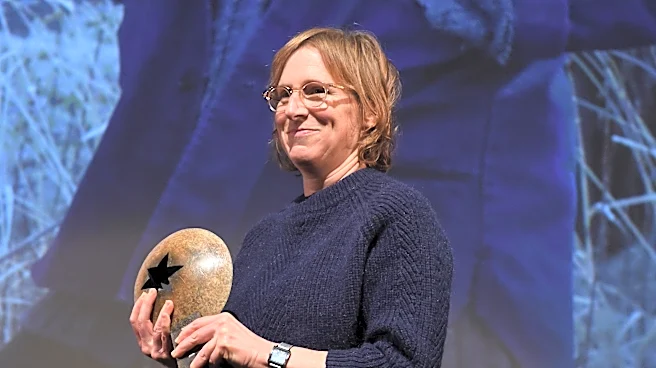
The documentary 'Nuisance Bear,' directed by Gabriela Osio Vanden and Jack Weisman, has been honored with the 2026 Werner Herzog Film Award for its "groundbreaking approach." This recognition follows its earlier success at the Sundance Film Festival,
where it received the Grand Jury Prize for Documentary (U.S. Documentary Competition). The film explores the complex interactions between polar bears and human civilization, particularly in the 'wildland–urban interface' (WUI) of Churchill, Manitoba. It delves into the struggles of these animals as they navigate a changing environment, often leading them into human settlements in search of food. The documentary features intimate footage of bears and also highlights the perspectives of indigenous communities, including the late Inuit elder Mike Tunalaaq Gibbons, who provides historical context on the impact of white incursions on their way of life and the bears' behavior.
Why It's Important?
The recognition of 'Nuisance Bear' with the Werner Herzog Film Award underscores its significant contribution to documentary filmmaking and environmental discourse. The award, named after a director known for his profound and often challenging explorations of nature and humanity, validates the film's unique perspective and artistic merit. The documentary's focus on the 'wildland–urban interface' offers a nuanced view of human-wildlife conflict, moving beyond simplistic narratives of climate change to examine the direct consequences of human expansion and cultural shifts on animal behavior. This film is crucial for raising awareness about the intricate challenges faced by polar bears and indigenous communities, prompting viewers to consider the broader ethical and ecological implications of human presence in natural habitats.
What's Next?
The documentary 'Nuisance Bear' is scheduled to screen on Saturday, November 7, at 5 p.m. at Camino Real Cinemas as part of the Wild and Free Film Festival. This screening provides an opportunity for the public to experience the film and engage with its themes. The accolades received, including the Werner Herzog Film Award and the Sundance Grand Jury Prize, are likely to increase its visibility and demand for wider distribution. This could lead to more screenings at other film festivals, educational institutions, and potentially a release on streaming platforms, making its important message accessible to a broader audience. The film's continued exposure will contribute to ongoing conversations about wildlife conservation, indigenous rights, and environmental stewardship.
Beyond the Headlines
Beyond its immediate narrative, 'Nuisance Bear' delves into the profound ethical and cultural dimensions of human-wildlife coexistence. The film's portrayal of the 'wildland–urban interface' as a 'habitat of inhumanity' challenges viewers to confront the systemic issues that displace both animals and indigenous peoples. The insights from Inuit elder Mike Tunalaaq Gibbons highlight the long-term consequences of colonial expansion and the disruption of traditional ecological knowledge. By focusing on the bears' perspective and the human impact on their lives, the documentary encourages a deeper empathy and a re-evaluation of anthropocentric views. It implicitly asks whether humanity can truly coexist with nature without fundamentally altering it, and what responsibilities come with our dominant role on the planet.