



What's Happening?
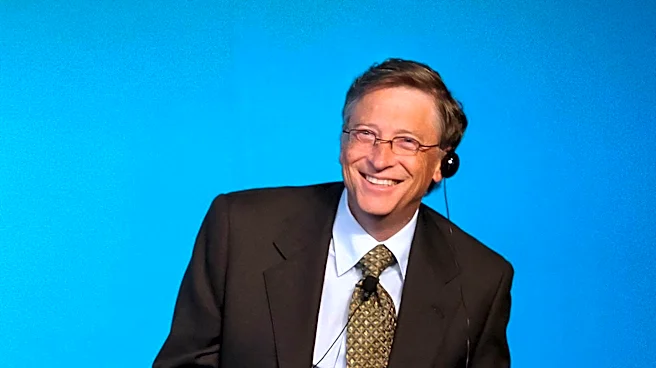
Bill Gates, co-founder of Microsoft, has stated that his programming skills, honed since he was 13, have become "basically obsolete" by late 2025 due to the rapid advancements in artificial intelligence (AI). In an interview with The Observer published
on October 25, Gates described the current era as an "evolutionary event," where AI is surpassing human capabilities in areas like mathematics, science, and engineering. He noted that his youthful ambition of becoming the world's best programmer is no longer attainable for an individual, as machines are now leading these advancements. Gates also discussed the potential for AI to impact various job sectors, including invention, administrative work, and physical labor through humanoid robots. He warned of a future where companies might opt to "hire the robot, fire the human, and not look back."
Why It's Important?
This declaration from a prominent figure like Bill Gates underscores the profound and accelerating impact of artificial intelligence on the global workforce and technological landscape. His observation that even his decades-long programming expertise is now outmoded by AI highlights the scale of disruption facing skilled labor. The potential for companies to replace human workers with AI and robots could lead to significant job displacement across various sectors, from highly technical roles to administrative and physical tasks. This shift could exacerbate economic inequality and strain social safety nets, as fewer human-generated incomes might be available to fund these programs. Gates's suggestion of an AI tax to fund social protections indicates a recognition of the severe economic challenges that could arise, prompting a critical discussion on how societies will manage this technological transition and support affected populations.
What's Next?
Looking ahead, the implications of AI's rapid advancement, as highlighted by Bill Gates, suggest a critical period of adjustment for economies and societies. Gates proposed exploring an AI tax to generate resources from the productivity gains of these technologies, which could be used to bolster social safety nets and assist those displaced by automation. He also suggested that certain jobs might need to be reserved exclusively for humans, prohibiting AI involvement to preserve human employment. These proposals indicate a growing need for policy discussions and regulatory frameworks to manage the transition. The ongoing development of AI is expected to continue accelerating, particularly in fields like medicine, where Gates believes it can expedite drug discovery and reduce healthcare waiting lists. The debate over AI's role in employment, ethics, and economic distribution is likely to intensify as these technologies become more sophisticated and integrated into daily life.
Beyond the Headlines
The obsolescence of Bill Gates's programming skills due to AI points to a deeper, less obvious implication: the potential for a fundamental redefinition of human value in the workforce. If even the most skilled and experienced individuals in technical fields can be outpaced by machines, it raises questions about the future of human expertise and creativity. This development could trigger a societal shift where the focus moves from traditional skill acquisition to areas where human attributes like emotional intelligence, complex problem-solving, and ethical reasoning remain paramount. The ethical dimension of AI's impact on employment, particularly the idea of reserving certain jobs for humans, suggests a future where policy might need to actively shape the division of labor between humans and machines. This could lead to new legal frameworks and cultural norms around work, potentially fostering a society that values human contribution beyond mere productivity, and re-evaluating the purpose of education and lifelong learning in an AI-dominated world.