







What's Happening?
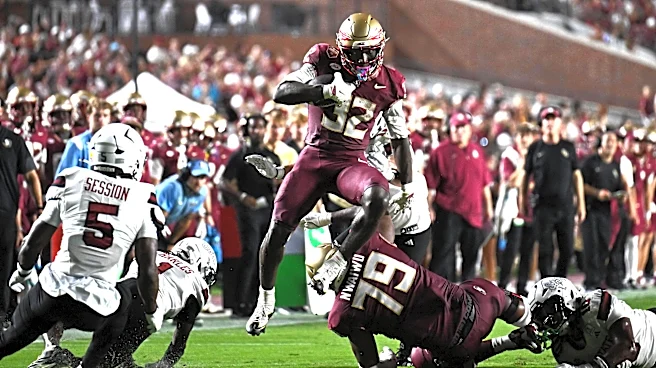
U.S. Senator Eric Schmitt, a Republican from Missouri, has successfully advanced a Senate resolution to recognize the 1960 Missouri Tigers college football team as national champions. The team achieved an 11-0 record and defeated Navy in the Orange Bowl.
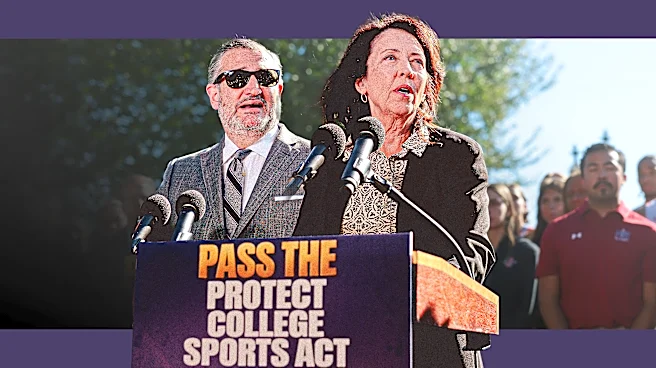
This recognition comes after Kansas later forfeited its win against Missouri, solidifying the Tigers' undefeated season. Senator Schmitt plans to honor the team during halftime at an upcoming Mizzou-Troy game. Currently, the NCAA officially recognizes Minnesota and Ole Miss as co-national champions for the 1960 season, creating a discrepancy with the Senate's resolution. This initiative highlights Senator Schmitt's active involvement in college athletics, as he is also a co-sponsor of the bipartisan Protect College Sports Act, which aims to regulate various aspects of college sports.
Why It's Important?
This Senate resolution carries significant symbolic importance for the University of Missouri and its athletic history, potentially altering the historical narrative of college football's 1960 season. While the NCAA's official records remain unchanged, a congressional recognition from the U.S. Senate provides a powerful endorsement for the 1960 Missouri Tigers' claim to a national title. This action could influence public perception and generate renewed interest in the team's legacy. Furthermore, Senator Schmitt's engagement in this matter, alongside his co-sponsorship of the Protect College Sports Act, underscores a broader political interest in college athletics. The ongoing debate over historical championships and the future regulation of college sports, including Name, Image, and Likeness (NIL) policies, reflects a growing intersection of sports, politics, and institutional recognition. This could set a precedent for other historical teams seeking similar congressional acknowledgment, potentially leading to more discussions about the accuracy and fairness of past athletic recognitions.
What's Next?
Following the Senate resolution, Senator Schmitt is scheduled to honor the 1960 Missouri Tigers at halftime during the upcoming Mizzou-Troy game. This event will serve as a public celebration of the team's achievements and the Senate's recognition. The NCAA's stance, which still lists Minnesota and Ole Miss as co-national champions for 1960, suggests that a full, official re-evaluation of the 1960 championship by the NCAA is not immediately expected. However, the Senate's action could exert informal pressure or encourage further discussion within college sports governing bodies regarding historical championship claims. The broader legislative efforts concerning college sports, such as the Protect College Sports Act, will continue to be debated in Congress, with Senator Schmitt playing a role in those discussions. The resolution for the 1960 Tigers may also inspire other universities or states to pursue similar legislative avenues for historical athletic recognitions.
Beyond the Headlines
The Senate's resolution for the 1960 Missouri Tigers touches upon deeper themes of historical revisionism and the role of political bodies in cultural and sporting narratives. While sports history is typically governed by athletic organizations, congressional intervention introduces a new dimension to how past achievements are validated. This raises questions about the criteria for such recognitions and whether political bodies should regularly weigh in on historical sporting outcomes. It also highlights the enduring passion and loyalty associated with college sports, where historical claims can still resonate decades later. The discrepancy between the Senate's recognition and the NCAA's official records could spark broader conversations about the authority of different institutions in defining historical truths, particularly in areas with significant public and emotional investment like college football. This event underscores the complex interplay between sports, public sentiment, and political action.