



What's Happening?
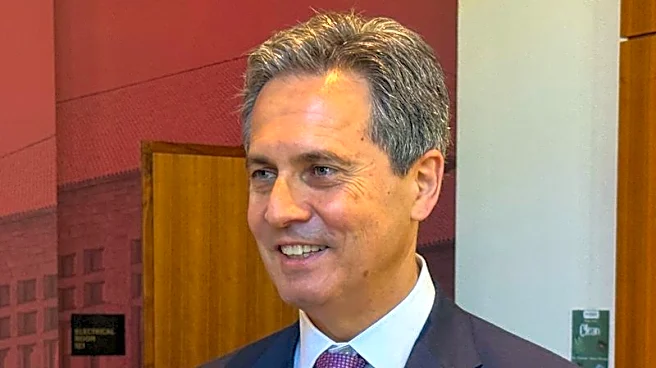
Alberto Musalem, an official with the St. Louis Federal Reserve, has indicated that the U.S. economy may require several interest rate increases before spring 2027 to achieve the Federal Reserve's 2% inflation target. Musalem stated that current policy
is not sufficiently restraining economic activity and that the real policy rate, which is the Fed's target rate minus inflation, needs to be between 2% and 2.5% by next spring. He estimates the current real policy rate is roughly a full percentage point below this desired range. This assessment suggests a potential path of up to four rate hikes at upcoming Federal Open Market Committee (FOMC) meetings, specifically in December, January, March, and April. The federal funds rate is currently set within a 3.75% to 4% range. While Musalem will not have a voting role on the FOMC during this period, his views will contribute to the 'dot plot' of policymakers' rate expectations.
Why It's Important?
Musalem's hawkish stance on interest rate hikes carries significant implications for the U.S. economy and financial markets. A series of rate increases would likely lead to higher borrowing costs for consumers and businesses, potentially dampening economic growth. Rate-sensitive assets, such as housing and certain stocks, could face downward pressure, and short-term yields would likely remain elevated. This approach aims to curb persistent inflation, which has been a key concern for the Federal Reserve. However, aggressive tightening could also increase the risk of a recession. Investors will be closely monitoring economic data, particularly related to growth, energy prices, shipping costs, and AI-related demand, to gauge which of Musalem's scenarios—either a need for more hikes or a less likely scenario where no more hikes are needed—will materialize. The potential for a wider rate differential between the U.S. and other economies, such as Canada, could also influence currency valuations, making the U.S. dollar more attractive to investors.
What's Next?
The immediate focus will be on the upcoming FOMC meetings, particularly in December, January, March, and April, as markets assess the likelihood and magnitude of potential rate hikes. While Musalem's views are influential, the collective decision of the FOMC will determine the actual path of monetary policy. Investors will be closely watching for any shifts in the Federal Reserve's communication and economic projections. The 'dot plot' of policymakers' rate expectations, which Musalem contributes to, will provide further insight into the consensus within the Fed. Additionally, the performance of key economic indicators, such as inflation rates, employment figures, and GDP growth, will play a crucial role in shaping future policy decisions. Any significant changes in energy prices or global supply chain dynamics could also influence the Fed's approach to interest rates.
Beyond the Headlines
The discussion around potential rate hikes extends beyond immediate economic impacts, touching upon the broader philosophy of monetary policy in managing inflation. Musalem's emphasis on the real policy rate highlights the Fed's commitment to achieving its inflation target, even if it means sustained tightening. This approach underscores the challenge central banks face in balancing price stability with economic growth. The differing views among Fed officials, even those without immediate voting power, reflect the complexity of economic forecasting and policy formulation. The potential for a 'higher real policy rate to happen in a balanced way, driven both by lower inflation and a higher nominal policy rate,' as Musalem suggests, points to an ideal scenario where inflation recedes naturally alongside policy adjustments. However, the acknowledgment that 'the nominal policy rate may need to do most of the work' indicates a readiness for more direct intervention if inflationary pressures persist. This ongoing debate within the Fed about the optimal path forward will continue to shape the economic landscape.