





What's Happening?
The International Monetary Fund (IMF) has issued a warning regarding the rapid increase in artificial intelligence (AI) investment, suggesting that while it currently supports global economic growth, a sudden downturn in this 'investment fever' could
trigger significant shocks to international financial markets. The IMF's World Economic Outlook recently revised its global economic growth forecast upwards, partly attributing this positive outlook to robust investment in AI infrastructure. However, the organization also highlighted several potential short-term risks to financial stability, including a slowdown in AI investment, rising government bond rates, and large-scale cyberattacks. These factors, if they materialize, could disrupt the current economic momentum driven by AI. The IMF's assessment underscores a dual perspective on AI's economic impact: a powerful driver of growth on one hand, and a potential source of systemic risk on the other, particularly if the speculative nature of current investment trends proves unsustainable.
Why It's Important?
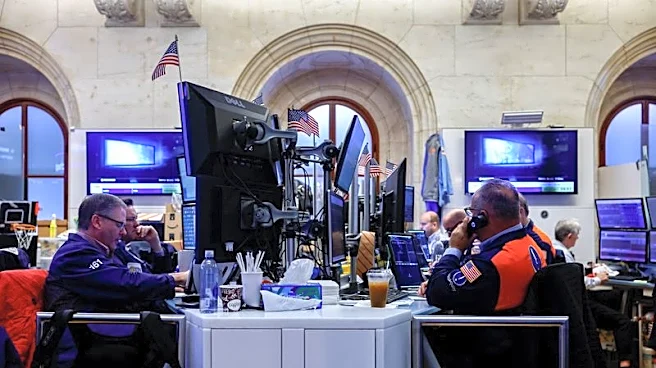
This warning from the IMF is crucial for U.S. industries, policymakers, and economic stakeholders as it highlights the potential fragility within the booming AI sector. A significant portion of global AI investment originates from or is directed towards the U.S., making the American economy particularly susceptible to any 'investment fever' breaking. A sudden decline in AI investment could lead to a contraction in the technology sector, impacting job markets, venture capital flows, and overall economic growth. Companies heavily invested in AI, from startups to tech giants, could face valuation corrections, affecting their ability to innovate and expand. For policymakers, the IMF's caution suggests a need to monitor AI investment trends closely and potentially consider regulatory frameworks that mitigate financial contagion risks without stifling innovation. The U.S. stands to lose if a speculative bubble in AI bursts, potentially leading to widespread financial instability and a slowdown in technological advancement.
What's Next?
In response to the IMF's concerns, financial regulators and central banks globally, including in the U.S., may increase their scrutiny of AI-related investments and market valuations. There could be a push for greater transparency in AI investment portfolios and a more cautious approach to lending in the sector. Businesses heavily reliant on AI investment for growth might need to diversify their funding sources or demonstrate clearer paths to profitability to reassure investors. Furthermore, discussions around international cooperation to manage the economic risks associated with AI are likely to intensify. The IMF's warning could also prompt a re-evaluation of risk management strategies within financial institutions that have significant exposure to AI-driven assets. The focus will likely shift towards ensuring sustainable growth in the AI sector, balancing innovation with financial prudence to prevent potential market shocks.
Beyond the Headlines
The IMF's warning extends beyond immediate financial implications, touching upon the broader societal and ethical dimensions of AI's rapid integration. The 'AI fever' reflects a societal belief in AI's transformative power, but an unchecked investment boom could lead to misallocation of resources, creating 'winner-take-all' scenarios that exacerbate economic inequality. Furthermore, the potential for large cyberattacks, identified by the IMF as a risk, highlights the increasing vulnerability of interconnected digital economies, where AI systems themselves could become targets or vectors for such attacks. This necessitates a deeper conversation about cybersecurity resilience and the ethical development of AI to prevent its misuse. The long-term shift could involve a more regulated and responsible approach to AI development and investment, moving away from purely speculative growth towards sustainable and equitable technological advancement, ensuring that the benefits of AI are broadly shared while its risks are effectively managed.