





What's Happening?
Hut 8, an energy infrastructure and digital compute company, announced a 45% increase in revenue, reaching $235.1 million in fiscal year 2025. This growth was primarily driven by its Compute segment, which saw revenue more than double to $202.3 million.
The company's gross margin expanded from 47% to 54%. According to CEO Asher Genoot, Hut 8 has strategically shifted its business model away from high capital expenditure Bitcoin mining towards contracted infrastructure cash flows, focusing on scaling AI data center infrastructure. This shift involved the carve-out of its legacy Bitcoin mining business into American Bitcoin and a renewed emphasis on power control, scalable campuses, and disciplined capital allocation. The company is currently undertaking site preparation for the second phase of its Beacon Point AI campus in Texas and is progressing with its River Bend AI data center project, with the first data center expected to come online in early Q2 2026.
Why It's Important?
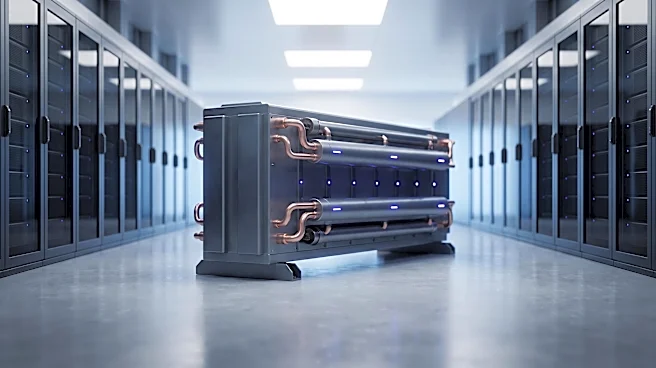
Hut 8's strategic pivot towards AI data center infrastructure is significant for the U.S. technology and energy sectors. By focusing on power-first development and securing long-term contracts with credit-worthy counterparties, Hut 8 aims to provide critical infrastructure for the rapidly expanding artificial intelligence market. This move positions the company to capitalize on the increasing demand for high-performance computing, which is essential for AI development and deployment. The company's emphasis on value engineering and innovation in infrastructure design, such as its Vega cooling technology, could set new industry standards for efficiency and cost-effectiveness in data center construction. Furthermore, Hut 8's approach to developing large-scale data centers in areas often overlooked by others, leveraging existing power infrastructure and favorable regulatory environments, could unlock new regions for technological growth and investment across the United States. This strategy also addresses the growing concern about power constraints and grid stability by integrating generation and load, potentially influencing future infrastructure development models.
What's Next?
Hut 8's immediate focus for 2026 is on execution and delivery, particularly bringing the River Bend AI data center online on time and within budget. The company plans to convert its development pipeline into additional contracted revenue and advance power origination efforts. Hut 8 is actively negotiating operational service agreements for its River Bend project and is exploring further expansion opportunities at other sites, such as Corpus Christi, leveraging its approved interconnect in ERCOT. The company also intends to remove Bitcoin exposure from its balance sheet, shifting its focus to equity ownership in American Bitcoin. In the medium term (2-5 years), Hut 8 aims to further value engineer its infrastructure stack to drive down costs and improve efficiency. Longer-term (5-10 years), the company plans to integrate AI and robotics into its infrastructure development processes, aiming to revolutionize how large-scale data centers are built and operated.
Beyond the Headlines
The shift by Hut 8 from Bitcoin mining to AI data center infrastructure highlights a broader trend in the digital compute industry, where companies are adapting to evolving technological demands and market dynamics. This transition underscores the increasing importance of AI as a primary driver for infrastructure investment and development. The company's 'power-first' development strategy, which involves identifying and securing power resources before building data centers, could become a blueprint for future large-scale infrastructure projects, especially as energy demands for AI continue to surge. The discussions around co-locating generation on-site with data centers and integrating load and generation into the grid reflect a growing recognition of the need for sustainable and resilient energy solutions in the face of increasing computational loads. This approach could lead to more localized and efficient energy ecosystems, reducing strain on existing grids and promoting regional economic development through infrastructure investment.