




What's Happening?
The Controlled Environment Agriculture (CEA) market is experiencing significant growth, with projections indicating it will expand from $90.42 billion in 2026 to $143.00 billion by 2031, achieving a Compound Annual Growth Rate (CAGR) of 9.6%. This growth is driven
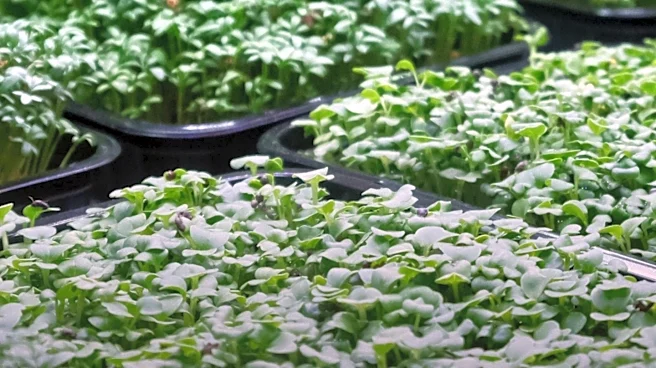
by increasing global food demand, shrinking arable land, water scarcity, climate variability, urbanization, and the need for consistent year-round fresh produce. CEA systems, which include greenhouses, vertical farms, indoor farms, and container farms, precisely manage environmental conditions such as temperature, humidity, lighting, and CO2 to optimize crop development. Key technological advancements, including AI, IoT, robotics, LED lighting, hydroponics, and automation, are making CEA systems more sophisticated. These technologies enable real-time monitoring of cultivation conditions and data-driven decisions regarding irrigation, nutrition, lighting, and temperature, leading to more consistent crop quality and improved productivity. Hydroponics, specifically, is expected to see the highest CAGR of 11.5% during this period due to its efficiency in nutrient and water management.
Why It's Important?
The expansion of the CEA market is crucial for addressing global food security challenges and promoting sustainable agricultural practices. With increasing pressure on water and arable land resources, CEA offers a resource-efficient alternative to traditional farming, reducing reliance on conventional soil cultivation and minimizing exposure to adverse weather conditions. The integration of AI and automation significantly enhances operational efficiency, allowing growers to optimize resource utilization and reduce labor constraints. This shift towards data-driven and automated farming systems can lead to more predictable crop output and quality, ensuring a consistent supply of fresh produce. Furthermore, the ability to establish CEA facilities closer to urban centers shortens supply chains, reduces transportation costs, and provides consumers with fresher, locally produced food. This localized production model is particularly beneficial in regions with limited land availability and growing demand for fresh produce, contributing to urban development and economic resilience.
What's Next?
The CEA market is expected to continue its trajectory towards highly automated, connected, energy-efficient, and data-driven cultivation systems. The convergence of AI, IoT, robotics, advanced lighting, hydroponics, precision irrigation, and climate-control technologies will create new opportunities for both commercial growers and technology providers. Future developments will likely focus on further integrating renewable energy sources and smart energy management platforms to reduce operational costs and enhance sustainability. Urban farming and localized food production are anticipated to remain significant growth areas, with vertical farms, rooftop greenhouses, and indoor farms becoming more prevalent in densely populated regions. As CEA technologies become more efficient and scalable, they are poised to play an increasingly vital role in building resilient food-production systems and supplying high-quality fresh produce closer to consumers, transforming the global agricultural technology ecosystem.
Beyond the Headlines
The rapid growth of Controlled Environment Agriculture, fueled by AI and automation, signifies a fundamental shift in how food is produced, with profound implications for environmental sustainability and economic structures. This technological revolution in agriculture could mitigate the environmental impact of traditional farming, such as excessive water usage and land degradation, by enabling more precise and efficient resource management. Ethically, it raises questions about access to technology and the potential for a two-tiered food system, where technologically advanced, high-quality produce might be more accessible to affluent populations. Culturally, the move towards indoor, urban farming could redefine our relationship with food production, potentially leading to a greater appreciation for local sourcing and controlled environments. Economically, it presents opportunities for new industries and job creation in technology development, data analytics, and specialized agricultural management, while potentially displacing traditional agricultural labor. The long-term shift could see agriculture becoming a high-tech industry, demanding a new skill set from its workforce and fostering innovation in sustainable practices.