



What's Happening?
Citigroup is strategically reorienting its credit card business to prioritize general-purpose and co-branded cards over private-label store cards. This shift was highlighted by Pam Habner, Head of U.S. Consumer Cards, at Citi’s 15th Annual FinTech Conference
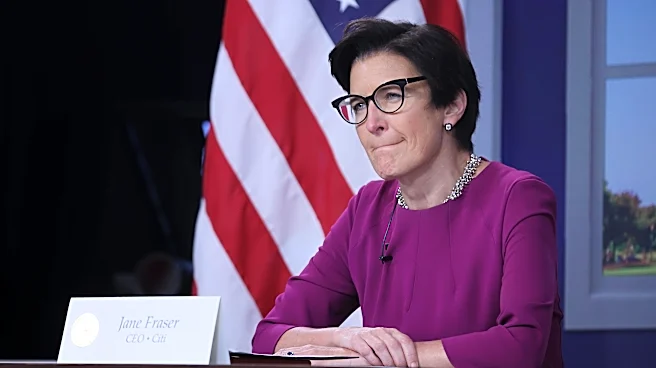
on November 10, 2026. Habner cited industry data indicating that general-purpose cardholders spend approximately nine times more and borrow four times more than private-label card customers, a trend Citi observes within its own portfolio. The U.S. credit card loan market is valued at about $1.2 trillion, with general-purpose cards constituting roughly 85% and projected to grow 5% to 6% annually, while private-label cards are expected to decline by approximately 3% annually. Citi's third-quarter 2026 results already reflect this change, with CEO Jane Fraser noting a 6% growth in total average loans from the general-purpose portfolio and a 13% rise in general-purpose spend volume, contrasting with a decline in private-label cards. The bank has also unified its legacy branded and retail card units into a single franchise, now one of Citi's five main businesses, serving around 70 million U.S. credit card customers.
Why It's Important?
This strategic pivot by Citigroup is significant as it aims to capture a more profitable segment of the U.S. credit card market. By focusing on general-purpose and co-branded cards, Citi is targeting customers who demonstrate higher spending and borrowing patterns, which can lead to increased interest income. The bank particularly values 'revolvers'—customers who regularly use their cards and occasionally carry balances—as they generate interest income without the elevated risk associated with heavily indebted borrowers. With an average card APR of 21.19%, these balances are crucial for profitability. Approximately 86% of Citi's card balances are held by consumers with FICO scores of 660 or higher, indicating a focus on lower-risk borrowers. While U.S. consumer card revenue was flat in the third quarter due to higher partner payments and rewards spending, the long-term strategy is to leverage the higher engagement of general-purpose cardholders to drive revenue growth, despite potential short-term expense increases from investments in new customer acquisition.
What's Next?
In the upcoming earnings reports, stakeholders will be closely watching whether the growth in general-purpose spend and loan volume begins to translate into increased card revenue, especially after accounting for partner payments and rewards costs. It will also be critical to monitor whether Citi's U.S. card net credit loss rate remains near its full-year 2026 expectation of around 4%. If the observed nine-times spending figure for general-purpose cardholders holds true within Citi's portfolio, the bank anticipates that card revenue will eventually align with the growth in spending. The continued integration and performance of co-branded portfolios, such as the American Airlines portfolio acquired from Barclays, will also be a key indicator of the success of this unified card franchise strategy. Citi's management has indicated that expense growth may outpace revenue growth in certain quarters as they invest in customer acquisition, suggesting a period of strategic investment before anticipated revenue acceleration.
Beyond the Headlines
This strategic shift by Citigroup reflects a broader trend in the financial services industry where banks are optimizing their portfolios for higher-value customer segments and more predictable revenue streams. The emphasis on co-branded cards also highlights the increasing importance of partnerships in the competitive credit card landscape, allowing banks to leverage established brand loyalty and customer bases. The focus on customers with higher FICO scores and those who occasionally carry balances indicates a sophisticated risk management approach, aiming to maximize interest income while mitigating credit risk. This strategy could lead to a more resilient and profitable credit card division for Citi in the long run, potentially influencing other major financial institutions to refine their own card strategies towards similar high-engagement, lower-risk customer profiles. The unification of card units also suggests an effort to streamline operations and enhance efficiency, which could yield further benefits beyond direct revenue growth.