
What's Happening?
TeraWulf (WULF) stock experienced a 14.39% decline to $9.34 in late-morning trading, reversing gains from the previous day. This selloff is attributed to a broader market unwinding of the AI infrastructure
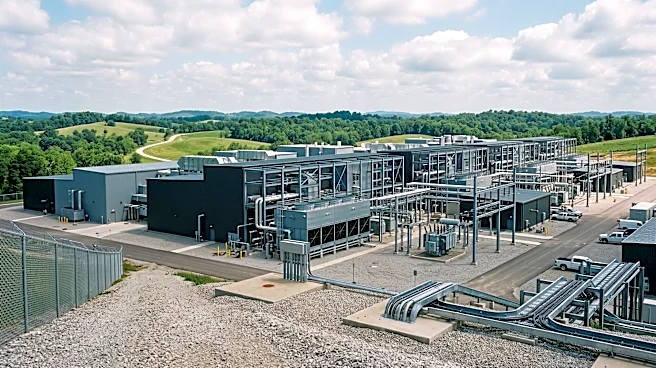
trade, Bitcoin's price falling below $60,000, and a strengthening dollar. Despite the stock's performance, TeraWulf CEO Paul Prager stated that the market downturn is impacting the company's stock price, not the underlying demand for its energy infrastructure assets. TeraWulf has significantly shifted its business model from Bitcoin mining to high-performance computing (HPC) leases, with approximately 83% of its revenue now derived from these leases. The company holds a 20-year lease agreement with AI developer Anthropic, which is backed by Google. However, TeraWulf's Muskie site in Kentucky currently lacks a signed tenant, exposing shareholders to potential funding costs. The company's next financial update is anticipated in late February.
Why It's Important?
The situation with TeraWulf highlights the volatility and interconnectedness of the technology, cryptocurrency, and AI infrastructure markets. While TeraWulf is transitioning to a more stable revenue model through long-term HPC leases with investment-grade companies, its stock remains susceptible to broader market sentiment, particularly in the tech and AI sectors. The company's ability to secure a tenant for its Muskie site is crucial, as it would help mitigate funding costs and demonstrate the viability of its energy infrastructure assets. The CEO's emphasis on the sustained demand for energy infrastructure, despite stock price fluctuations, underscores a potential disconnect between market perception and fundamental business value in rapidly evolving sectors. This scenario also reflects the challenges faced by companies adapting their core business in response to market shifts, such as the pivot from Bitcoin mining to AI infrastructure.
What's Next?
TeraWulf is expected to provide its next financial update in late February, which will offer more insight into its operational performance and progress. The company is actively seeking a tenant for its Muskie site in Kentucky, with CEO Paul Prager indicating discussions with three hyperscalers and two leading AI model developers. These prospective tenants are reportedly exploring ways to assist with funding if costs increase. The approval from Kentucky's utility regulator for TeraWulf to raise contracted power at Muskie from 500 MW to one gigawatt is also a key development to watch. The outcome of these negotiations and regulatory decisions will significantly influence TeraWulf's financial stability and future growth trajectory, particularly regarding its ability to fund the Muskie build without further share dilution.
Beyond the Headlines
The case of TeraWulf illustrates a broader trend of infrastructure companies adapting to the burgeoning demands of the artificial intelligence industry. The shift from Bitcoin mining to HPC leases signifies a strategic pivot towards a more stable and potentially lucrative market driven by the exponential growth of AI. This transition also brings into focus the critical role of energy infrastructure in supporting advanced computing needs. The scarcity of permitted sites for new data center projects, as highlighted by CEO Prager, underscores the strategic value of TeraWulf's assets. The company's reliance on long-term contracts with investment-grade customers, backed by entities like Google, suggests a move towards de-risking its business model, even as its stock experiences short-term market volatility. This evolution reflects the ongoing convergence of energy, technology, and finance in the digital economy.