






What's Happening?
Muhammad Airell Amsyar Anuar, a 19-year-old from Kampung Banggol Pak Esah, Kelantan, has garnered attention for his skill in crafting traditional wayang kulit (shadow puppetry) puppets. Inspired by his late uncle, Mohd Nor Salleh, an experienced puppet maker,
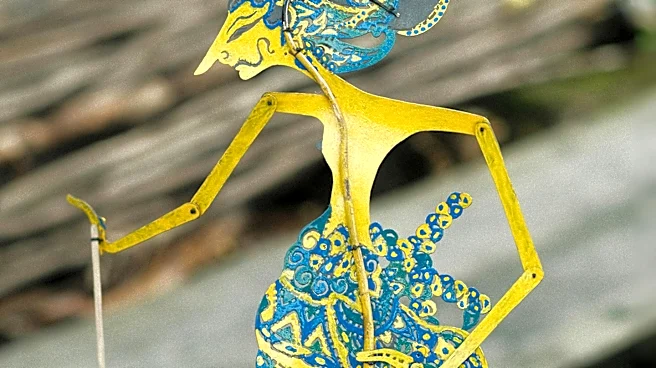
Airell began making puppets in school and started accepting orders at age 15. He meticulously creates puppets from cow or goat hide, a process that involves drying the hide, tracing customer-provided designs, carving, attaching bamboo rods, and intricate painting. The choice of hide depends on the character, with cowhide used for more robust figures like 'Hanuman' and goat hide for characters such as 'Seri Rama' and 'Seri Dewi'. Airell employs about 20 types of specialized punches to create patterns and ensures both sides of the puppet are painted identically, a complex step that requires sanding if mistakes occur. The time to complete a puppet ranges from two days to a week, depending on its size and design complexity. His popular puppets, including 'Seri Rama' and 'Seri Dewi', sell for between RM150 and RM700, with orders coming from across the state for performances, decoration, or as collector's items. Airell is also an active 'Tok Dalang' (wayang kulit storyteller) and plays the serunai, performing at cultural events.
Why It's Important?
Airell's dedication to wayang kulit puppetry is significant for the preservation and revitalization of traditional arts in the region. In an era dominated by digital entertainment, a young artisan embracing and excelling in a centuries-old craft helps ensure its continuity and relevance for future generations. His success in attracting orders and engaging with the art form as both a maker and performer demonstrates a viable path for cultural entrepreneurship. This not only provides him with an income but also contributes to the local economy by sustaining a niche market for traditional crafts. Furthermore, his involvement as a 'Tok Dalang' and musician highlights the multifaceted nature of wayang kulit, emphasizing its role as a comprehensive storytelling medium that combines visual art, music, and narrative. His aspiration to penetrate international markets could elevate the global recognition of Malaysian traditional arts, fostering cultural exchange and appreciation.
What's Next?
Airell aims to further develop his skills and expand his reach into international markets, which could lead to broader recognition for wayang kulit puppetry. This ambition suggests potential collaborations with cultural institutions, participation in international art festivals, or online sales platforms to reach a global audience. His continued involvement in performances as a 'Tok Dalang' will likely increase his visibility and demand for his puppets. There is also potential for him to mentor younger individuals, passing on his knowledge and skills to ensure the art form's longevity. As he gains more experience and exposure, he might explore creating more complex or custom-designed puppets, further diversifying his offerings. His efforts could inspire other young people to engage with traditional arts, fostering a new generation of artisans and performers dedicated to preserving cultural heritage.
Beyond the Headlines
Airell's story transcends simple craftsmanship; it represents a broader cultural movement where younger generations are re-engaging with their heritage. In a rapidly modernizing world, the choice of a teenager to dedicate himself to a traditional art form like wayang kulit speaks to the enduring appeal and cultural significance of such practices. It challenges the notion that traditional arts are solely for older generations, demonstrating their potential to captivate and inspire youth. This engagement also highlights the importance of intergenerational knowledge transfer, as Airell's skills were nurtured by his late uncle. His use of platforms like TikTok (Airell_SP_Official) to promote his work signifies a modern approach to preserving tradition, bridging the gap between ancient art forms and contemporary digital engagement. This blend of tradition and modernity is crucial for the survival and evolution of cultural heritage in the 21st century, ensuring that these art forms remain dynamic and accessible.